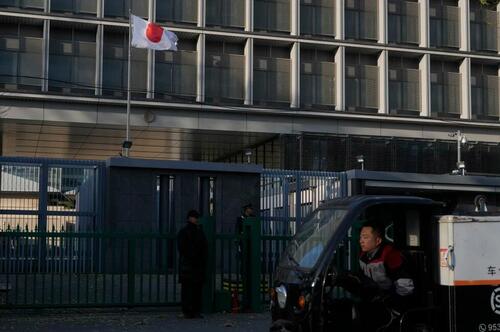
China Escalates Export Curbs on Japanese Defense-Linked Firms, Broadening Trade Weaponization Beyond US Rivalry
Credible sources corroborate China's June 2026 export controls on 40 Japanese entities over military concerns, revealing deepening trade tensions and supply chain risks tied to Japan's defense buildup and regional alliances.
China's Ministry of Commerce on June 29, 2026, added 20 Japanese entities to its export control list and 20 more to a watch list, prohibiting or scrutinizing exports of dual-use items to firms and institutes tied to Japan's military expansion. The measures target entities including the National Institute for Defense Studies, ground/naval/air systems research centers, and divisions of Mitsubishi Heavy Industries, Mitsubishi Electric, Mitsui E&S, Fujitsu, Komatsu, Terra Drone, and others involved in ship engines, drones, and nuclear fuel processing.
Beijing framed the curbs as justified deterrence against Japan's "remilitarization" and pursuit of "new militarism," citing Prime Minister Sanae Takaichi's comments on potential intervention over Taiwan and Tokyo's accelerated acquisition of offensive capabilities like long-range missiles deployed on remote islands such as Minamitorishima. Japan condemned the moves as "unacceptable," vowing countermeasures while continuing defense budget increases and policy revisions.
This escalation builds on an initial February 2026 round of similar controls, signaling a pattern of using export restrictions on dual-use goods—materials with both civilian and military applications—as diplomatic leverage. Credible reporting from Reuters, AP News, Bloomberg, and the Financial Times confirms the lists and rationales align with official Chinese statements.
Beyond bilateral friction, these actions illustrate the weaponization of trade extending into supply chain vulnerabilities across the Indo-Pacific. Japan's defense firms and research bodies face heightened barriers to Chinese-origin components, potentially disrupting sectors from aerospace and shipbuilding to semiconductors and rare earth-dependent technologies. This mirrors broader de-risking trends where allies diversify away from single-source dependencies, accelerating trilateral US-Japan security cooperation and prompting Japanese firms to seek alternative suppliers in Europe, Southeast Asia, or domestic production.
Analysts note the measures function partly as signaling amid stalled diplomatic stabilization, with limited immediate economic spillover claimed by Beijing but real risks to global dual-use item flows. Connections to wider patterns include parallels with controls on rare earths and tech exports, underscoring how economic statecraft fragments alliances and supply networks far beyond US-China dynamics.
[Supply Chain Analyst]: These curbs accelerate fragmentation of dual-use tech flows, forcing Japanese and allied firms to diversify sourcing and bolstering regional de-risking initiatives beyond narrow US-China framing.
Sources (5)
- [1]China imposes export controls on 20 Japanese entities to curb 'remilitarisation'(https://www.reuters.com/world/asia-pacific/china-adds-20-japanese-entities-export-control-list-2026-02-24/)
- [2]China imposes export controls on 40 Japanese entities as tensions with Tokyo rise(https://apnews.com/article/china-japan-watch-list-military-export-1c9241dcd05560f1076a58b5953d99b5)
- [3]China Adds 20 Japanese Firms to Export Control List, Ramping Tensions With Tokyo(https://www.bloomberg.com/news/articles/2026-02-24/china-puts-export-curb-on-japan-firms-including-mitsubishi-heavy)
- [4]China adds 20 Japanese entities to export-control list over remilitarisation concerns(https://www.scmp.com/economy/china-economy/article/3358686/china-adds-20-japanese-entities-its-export-control-list)
- [5]China adds 20 Japanese entities to export control list(https://www3.nhk.or.jp/nhkworld/en/news/20260629_B3/)