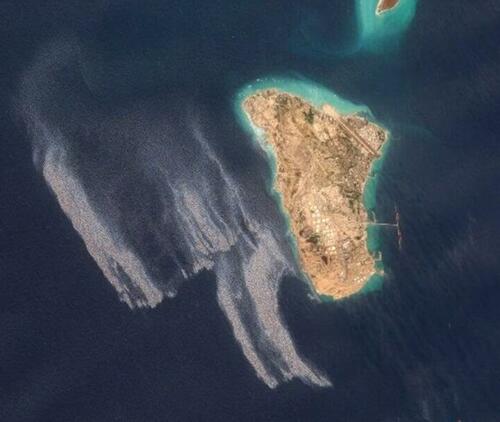
Massive Oil Slick Near Iran's Kharg Island: Environmental and Geopolitical Ripples in the Persian Gulf
A massive oil slick near Iran's Kharg Island, detected by satellite imagery, threatens environmental disaster and energy supply disruptions. Beyond the immediate spill, the incident highlights geopolitical tensions, economic risks, and systemic vulnerabilities in the Persian Gulf, with potential impacts on global oil markets and regional diplomacy.
A significant oil slick, spanning approximately 45 square kilometers, has been detected off Iran's Kharg Island, the country's primary crude oil export terminal handling roughly 90% of its oil exports. Satellite imagery from Copernicus's Sentinel-1, Sentinel-2, and Sentinel-3 missions, captured between May 6 and 8, reveals the slick extending westward from the island, as reported by Reuters and The New York Times. While the exact cause remains unknown—potentially a leak, infrastructure failure, or overflow due to storage constraints amid sanctions and blockades—the incident raises urgent environmental and economic concerns in an already tense geopolitical region.
Kharg Island's strategic importance cannot be overstated. As a linchpin of Iran's energy sector, any disruption here could ripple through global oil markets, especially given existing volatility driven by Middle Eastern conflicts and sanctions on Iranian oil. The timing of the spill coincides with reported clashes between Iranian forces and U.S. vessels in the Strait of Hormuz, as noted by Iran's Fars news agency on the same day the slick was detected. Although details of these skirmishes remain murky, the overlap suggests a possible correlation—whether through direct damage to infrastructure or as a byproduct of heightened military activity disrupting normal operations.
What the initial coverage misses is the broader context of recurring environmental hazards in the Persian Gulf tied to geopolitical strife. Historical patterns, such as the 1991 Gulf War oil spill—where Iraqi forces deliberately released millions of barrels into the Gulf—highlight how conflict and environmental disasters often intersect in this region. Unlike that intentional act, the Kharg Island incident appears accidental, but the lack of transparency from Iranian authorities, compounded by sanctions limiting access to modern spill-response technology, exacerbates risks of escalation. If the slick reaches the coasts of neighboring Gulf states, as feared by regional commentators on social media, it could strain already fragile diplomatic ties, particularly with Saudi Arabia and the UAE, both of whom have clashed with Iran over regional influence.
Moreover, the potential economic fallout is significant. With global oil prices already sensitive to Middle Eastern instability, a prolonged disruption at Kharg Island could tighten supply, driving up costs and fueling inflationary pressures worldwide. This is especially critical as the U.S. and Europe grapple with energy security amid reduced Russian supplies post-Ukraine invasion. The International Energy Agency (IEA) has warned in its 2023 World Energy Outlook that any additional supply shocks in the Gulf could push oil prices beyond $100 per barrel, a threshold with severe implications for global inflation.
Another overlooked angle is the environmental toll. The Persian Gulf's ecosystem, already stressed by frequent spills and industrial activity, faces long-term damage from such incidents. The 2019 Abqaiq-Khurais attack on Saudi oil facilities, while not directly causing a spill, underscored how energy infrastructure in the region is a perennial target, often with collateral environmental costs. If the Kharg Island slick stems from conflict-related damage, it could signal a new phase of hybrid warfare where environmental sabotage becomes a tactic—though no evidence currently supports this theory.
In synthesizing these perspectives, the Kharg Island incident is not just an isolated spill but a flashpoint that encapsulates the intersection of energy security, environmental risk, and geopolitical tension. While initial reports focus on the visual extent of the slick, they underplay the systemic vulnerabilities of relying on a single export hub in a conflict zone. Until the cause is clarified, speculation will persist, but the stakes are clear: a failure to contain this spill—both physically and diplomatically—could amplify existing fractures in the Gulf and beyond.
MERIDIAN: If the Kharg Island oil slick disrupts Iran's export capacity for over a week, expect oil prices to spike by 5-10%, intensifying global inflationary pressures. Regional tensions may also escalate if neighboring states are affected by the spill.
Sources (3)
- [1]Massive Oil Slick Spotted Off Iran's Kharg Island, Cause Unknown(https://www.zerohedge.com/geopolitical/massive-oil-slick-spotted-irans-kharg-island-cause-unknown)
- [2]International Energy Agency World Energy Outlook 2023(https://www.iea.org/reports/world-energy-outlook-2023)
- [3]United Nations Environment Programme - Gulf War Oil Spill Report(https://www.unep.org/resources/report/environmental-assessment-kuwait-following-1991-gulf-war)