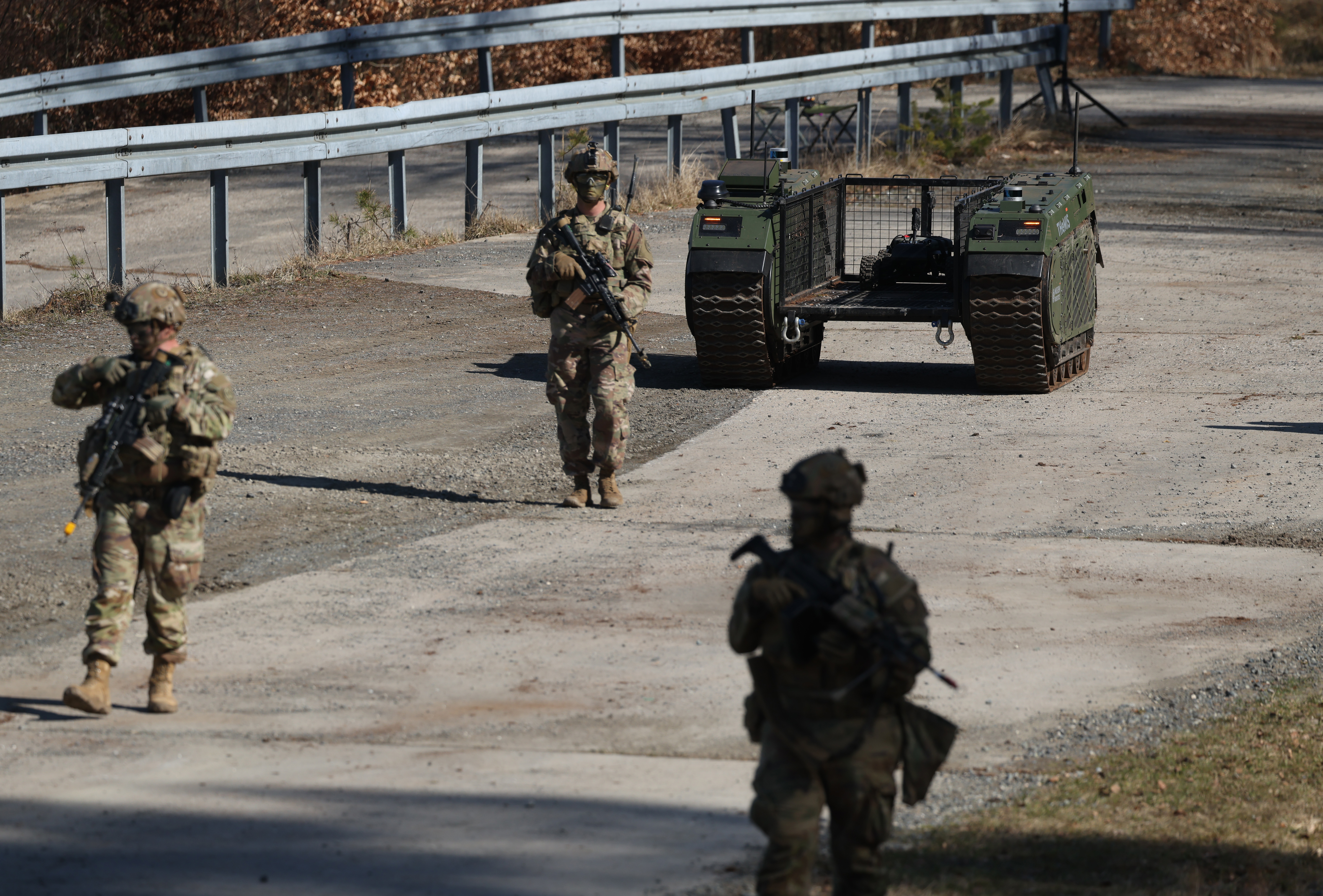
Dutch THeMIS Production Line Exposes Europe's Unmanned Pivot: Supply Chain Autonomy Meets Ukraine's Attrition War
Dutch THeMIS factory accelerates Europe's unmanned ground systems output for Ukraine, revealing supply autonomy gains and escalation risks missed in initial reporting.
The new Born assembly facility, operated jointly by Estonia's Milrem Robotics and VDL Defentec, marks more than a localized production win—it signals Europe's accelerating bid to decouple unmanned ground vehicle output from U.S. supply bottlenecks. While the Defense News report correctly notes the first THeMIS handover to Dutch forces for onward transfer to Ukraine, it underplays how this setup directly addresses the 2022-2025 pattern of delayed Western aid packages that left Kyiv reliant on ad-hoc commercial drone procurement. Drawing from Milrem's own technical disclosures and Dutch Ministry of Defence procurement records, the plant's flexible electric-propulsion line enables rapid reconfiguration between cargo, ISR, and weaponized variants, a capability Ukrainian operators have validated since initial 2022 deployments near Bakhmut. This development connects to broader NATO trends documented in the 2025 European Defence Agency report on robotic systems, where ground UGVs are projected to offset infantry exposure amid Russia's massed Lancet and fiber-optic drone campaigns. Original coverage misses the geopolitical friction: by routing production through neutral-leaning Dutch infrastructure, the arrangement tests EU unity on lethal autonomous exports, potentially inviting Russian accusations of NATO escalation while easing pressure on strained U.S. foreign military financing. Analysis of VDL's armored vehicle integration expertise suggests this model could scale to 200+ units annually, outpacing Estonia's domestic constraints and offering a template for Franco-German initiatives under the European Defence Fund. The risk lies in proliferation—similar UGVs appearing in non-state actor hands—or Russian mirroring via Iranian and North Korean tech transfers, reshaping the drone-saturated front lines into a true robotic arms race.
SENTINEL: Scaled Dutch output will normalize UGV integration into NATO doctrine within 18 months, yet invites symmetric Russian countermeasures that prolong Ukraine's resource drain.
Sources (3)
- [1]Primary Source(https://www.defensenews.com/global/europe/2026/06/04/dutch-plant-for-combat-zone-robots-offers-fresh-supply-pipeline-for-ukraine/)
- [2]Milrem Robotics Technical Overview(https://milremrobotics.com/themis/)
- [3]European Defence Agency Robotic Systems Assessment 2025(https://eda.europa.eu/docs/default-source/documents/eda-robotic-systems-report-2025.pdf)