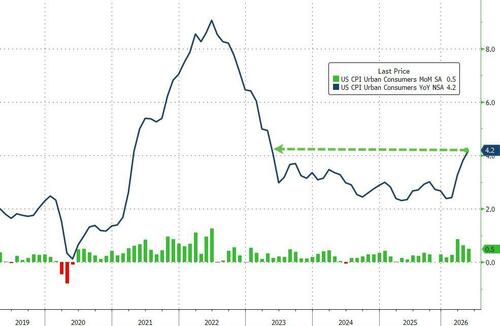
CPI Breach of 4% and Real Wage Contraction Signal Policy Trade-offs Between Energy Costs and Household Resilience
May CPI at 4.2% YoY coincides with the first real-wage decline since April 2023, driven chiefly by energy while core services accelerate; primary BLS figures indicate policy must weigh commodity volatility against service-price inertia without assuming uniform inflation dynamics.
The May CPI release from the Bureau of Labor Statistics documents headline inflation at 4.2% year-over-year, the first such reading above 4% since April 2023, with energy contributing over 60% of the monthly increase and shelter adding steady pressure. Real average hourly earnings declined on a year-over-year basis for the first time since that same period, confirming an erosion of purchasing power that nominal wage gains have failed to offset. Primary BLS data further show core services ex-shelter rising 3.49% annually while goods prices posted their first deflationary month in twelve, illustrating a bifurcated price path rather than uniform resurgence. This pattern connects to earlier energy-driven episodes documented in the Federal Reserve's 2022-2023 transcripts, where similar commodity spikes preceded broader service-cost stickiness without immediate monetary offset. One perspective, drawn from BLS employment reports, emphasizes labor-market tightness sustaining nominal wage growth that partially cushions the impact; another, reflected in Energy Information Administration weekly petroleum data, highlights how global supply constraints amplify domestic energy pass-through. A third view, visible in Congressional Budget Office baseline projections, frames the episode as a test of fiscal transfers' ability to stabilize real incomes amid volatile input costs. The original coverage understates the persistence of core-service acceleration and overlooks how BLS revisions to prior months alter the trajectory of real-wage comparisons. Cross-referencing the May CPI with contemporaneous BEA personal-income releases reveals that transfer payments have masked but not reversed the contraction in wage-and-salary purchasing power.
[MERIDIAN]: Persistent energy contributions to CPI above 4% may compel targeted fiscal offsets rather than broad rate adjustments, as real-wage erosion concentrates pressure on lower-income cohorts documented in BLS distribution tables.
Sources (3)
- [1]Bureau of Labor Statistics CPI News Release May 2025(https://www.bls.gov/news.release/cpi.nr0.htm)
- [2]Bureau of Economic Analysis Personal Income and Outlays May 2025(https://www.bea.gov/news/2025/personal-income-and-outlays-may-2025)
- [3]Federal Reserve FOMC Meeting Transcript April 2023(https://www.federalreserve.gov/monetarypolicy/fomcminutes202304.htm)