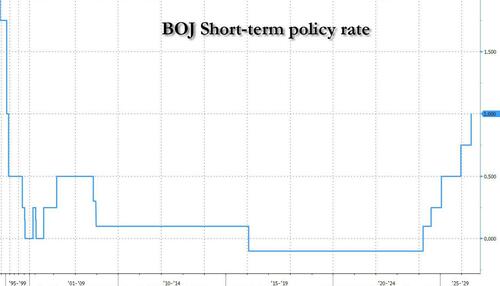
Bank of Japan Hikes Policy Rate to 1%—Highest Since 1995—Marking Normalization Milestone Amid Energy-Driven Inflation and Lingering Carry-Trade Risks
Corroborated BoJ rate hike to 1% ends ultra-loose era with documented ties to energy inflation and carry-trade exposures; mainstream sources confirm facts while under-emphasizing broader global financial interconnections.
On June 16, 2026, the Bank of Japan (BoJ) raised its short-term policy rate by 25 basis points to around 1%, the highest level since September 1995, in a 7-1 vote at its Monetary Policy Meeting. The decision, widely anticipated by markets, came amid surging global energy prices linked to Middle East tensions and signals the central bank's ongoing shift away from ultra-loose monetary policy that has persisted for decades.
The BoJ cited reduced downside risks to the economy and the potential for underlying CPI inflation to exceed its 2% target due to faster pass-through of higher fuel costs. Deputy Governor Uchida noted at the press conference that the move aligns with developments in economic activity, prices, and financial conditions. One dissent came from board member Toichiro Asada, appointed under the dovish Takaichi administration, who highlighted greater risks from the Middle East situation to production and employment.
Governor Kazuo Ueda was absent due to medical treatment, marking the first such meeting without him. The BoJ also announced it would level off JGB purchases at around ¥2 trillion per month starting April 2027, easing the pace of balance sheet contraction.
This hike follows prior increases since exiting negative rates in 2024 and reflects a gradual normalization path, with economists eyeing potential further 0.25% rises later in 2026. Official BoJ statements emphasize continued vigilance on inflation upside risks while maintaining accommodative financial conditions overall.
Beyond domestic policy, the move intersects with global dynamics. A narrowing interest rate differential with major economies has sustained yen carry trades—borrowing in low-yielding yen to invest in higher-yielding assets—though prior BoJ tightening episodes (e.g., 2024) triggered volatility and partial unwinds affecting equities, emerging markets, and risk assets. Yen weakness persists around 160 per dollar, prompting intervention concerns, while analysts note that sustained hikes could pressure these leveraged positions, with ripple effects on global liquidity and currency markets that some mainstream coverage frames primarily through inflation lenses rather than systemic carry-trade vulnerabilities.
[Market Strategist]: Further BoJ tightening could accelerate partial carry-trade unwinds, amplifying yen volatility and pressuring leveraged global positions in equities and emerging assets beyond immediate inflation narratives.
Sources (7)
- [1]Japan raises interest rate to highest for 31 years(https://www.bbc.com/news/articles/cjdgl213dpzo)
- [2]Bank of Japan raises interest rates to 31-year high(https://www.reuters.com/world/asia-pacific/bank-japan-set-raise-rates-31-year-high-vow-further-increases-2026-06-15/)
- [3]Bank of Japan raises interest rates to 31-year high amid Iran war inflation pressures(https://www.theguardian.com/business/2026/jun/16/bank-of-japan-raises-interest-rates-iran-war-inflation-us-fed-bank-of-england)
- [4]Bank of Japan Lifts Rates to 31-Year High(https://www.wsj.com/economy/central-banking/bank-of-japan-lifts-rates-to-31-year-high-a19871eb)
- [5]Change in the Guideline for Money Market Operations(https://www.boj.or.jp/en/mopo/mpmdeci/mpr_2026/k260616a.pdf)
- [6]Japan Interest Rate(https://tradingeconomics.com/japan/interest-rate)
- [7]Yen short bets jump to nine-year high as carry trade revives(https://www.japantimes.co.jp/business/2026/06/15/markets/yen-carry-trade-revive/)