Even Nordics Slip: WJP 2026 Index Reveals Persistent Global Rule of Law Recession, Echoing EU Oversight Gaps
WJP 2026 data and Liberties analysis corroborate rule-of-law erosion across Europe, including slight Nordic declines, amid a global recession and persistent EU recommendation non-implementation, pointing to systemic vulnerabilities in democratic safeguards.
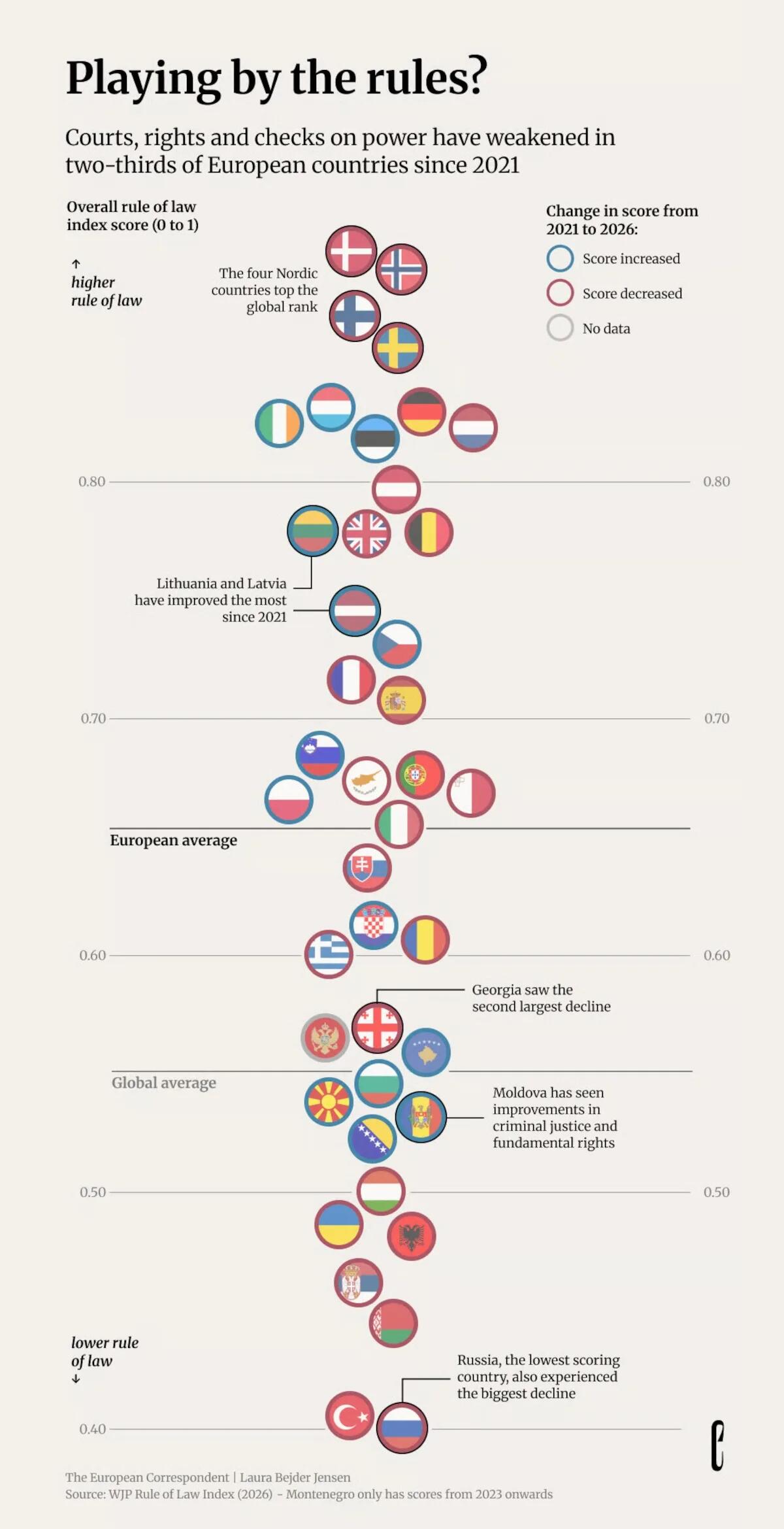
The World Justice Project's Rule of Law Index 2026, released October 21, confirms a ninth consecutive year of net global decline, with scores falling in 62% of 143 countries versus improvements in 38%. Top-ranked nations—Denmark (0.898–0.90 range across reports), Norway, Finland, and Sweden—each posted small five-year drops of 0.002–0.010 points, underscoring that even traditionally robust Nordic institutions are not immune. Germany slipped 0.010 to 0.830; the UK fell 0.007 to 0.778. Steepest European declines hit Russia (-0.062), Georgia, Serbia, and Belarus, while Latvia and Lithuania improved most.
The index's eight factors highlight weakening constraints on government powers, driven by diminished non-governmental checks and judicial limits on executives in 63% of nations. Freedom of expression, assembly, and civic participation declined in 64–67% of countries. WJP Executive Director Alejandro Ponce noted that over 86% of countries have seen sustained five-year erosion in at least one anti-authoritarian safeguard, entrenching authoritarian practices.
Complementing this, the Civil Liberties Union for Europe's (Liberties) 2026 Rule of Law Report and Gap Analysis reveal that 96% of European Commission recommendations from prior cycles remain unimplemented, with 54% showing no or limited progress. Even in Denmark and Sweden, emerging concerns around civic space and oversight receive insufficient early warnings. This implementation gap—repeating 93% of prior recommendations—suggests monitoring mechanisms record rather than reverse erosion, with potential spillover to global governance norms as high performers normalize incremental slippage.
Broader connections emerge in how regulatory enforcement and justice system independence falter under executive pressure, linking Nordic micro-declines to EU-wide patterns and non-EU states. The trend signals risks to democratic resilience beyond headline laggards, warranting scrutiny of institutional self-correction capacity.
Sources (6)
- [1]WJP Rule of Law Index 2026 Global Press Release(https://worldjusticeproject.org/news/wjp-rule-law-index-2026-global-press-release)
- [2]India Drops to 88th in WJP Rule of Law Index 2026(https://indianexpress.com/article/trending/top-10-listing/wjp-rule-of-law-index-2026-india-drops-to-88th-rank-denmark-tops-list-10938968/)
- [3]Thailand ranks 80th in global rule of law index 2026(https://www.khaosodenglish.com/news/2026/10/28/thailand-ranks-80th-in-global-rule-of-law-index-2026/)
- [4]Rule of law recession persists globally(https://www.lawsociety.ie/gazette/top-stories/2026/october/rule-of-law-recession-persists-globally/)
- [5]The EU rule of law report: a tool that records rather than prevents?(https://www.liberties.eu/en/stories/gap-analysis-2026/45807)
- [6]EU’s Rule of Law Report Risks Becoming Toothless, Says Liberties(https://balkaninsight.com/2026/10/12/eus-rule-of-law-report-risks-becoming-toothless-says-liberties/rd/)