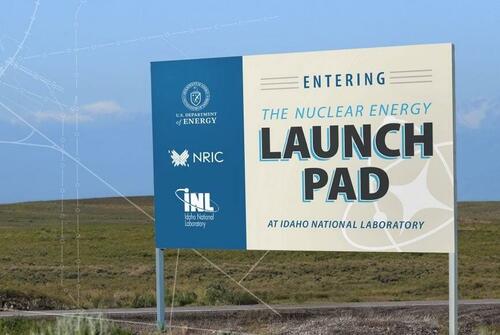
Senate NEIDA Bill Carves DOE Fast Lane for Commercial Nuclear on Federal Lands, Aligning with Genesis AI Mission to Meet Explosive Data Center Demand
NEIDA legislation by Sens. Lee and McCormick would empower DOE to license commercial nuclear reactors on federal lands, creating a 'Launch Pad' to bypass NRC delays for advanced tech demos transitioning to commercial use. Tied to AI power needs via the Genesis Mission, it repurposes plutonium, accelerates deployment against China/Russia competition, and challenges slow regulatory and anti-nuclear environmental narratives with pragmatic federal pathways.
Senators Mike Lee (R-UT) and Dave McCormick (R-PA) introduced the Nuclear Energy Innovation and Deployment Act (NEIDA) on April 14, 2026, marking a notable policy shift aimed at accelerating advanced nuclear deployment amid surging U.S. electricity demand driven by AI infrastructure and manufacturing. The legislation clarifies and expands the Department of Energy's (DOE) authority to license and oversee commercial reactors and fuel-cycle facilities on federal land or for federal purposes, including those supplying power to federal marketing agencies. It also establishes a permanent Nuclear Energy Launch Pad program on DOE and national laboratory sites, creating streamlined pathways from demonstration to commercial operation under DOE oversight rather than defaulting to full Nuclear Regulatory Commission (NRC) processes.[1][2]
This framework directly addresses the longstanding 'valley of death' between pilot projects and full commercialization that has hampered U.S. nuclear innovation while China and Russia advance rapidly. By repurposing surplus plutonium as reactor fuel and extending Price-Anderson liability protections, NEIDA transforms legacy nuclear liabilities into domestic fuel supply chains, linking national security priorities with energy production. Critically, it builds on recent DOE initiatives and executive actions to compress timelines dramatically—potentially enabling projects like Oklo's Aurora powerhouse at Idaho National Laboratory (INL) to transition seamlessly from testing to commercial operations supplying nearby AI-linked facilities.[3]
A deeper connection emerges with the DOE's Genesis Mission, launched in late 2025 as a national effort to harness AI for breakthroughs in energy, science, and security. Genesis explicitly targets challenges in nuclear deployment timelines, grid integration for massive data center loads, and co-location of advanced computing with reliable baseload power sources. NEIDA's federal land carve-out could enable secure, co-located nuclear-data center complexes on DOE property, bypassing traditional NRC bottlenecks and some state-level environmental reviews. This aligns with Genesis priorities for '20-100x faster decision-making' on grid planning and de-risking data center integration to support AI dominance—revealing how AI-driven power hunger (projected to require hundreds of gigawatts) is forcing pragmatic policy realignments that challenge both strict regulatory paradigms and segments of the environmental movement historically skeptical of nuclear expansion.[4][5]
Unlike comprehensive NRC overhaul, NEIDA creates a targeted fast lane on federal real estate, where private developers fund projects but gain infrastructure and regulatory certainty. This pragmatic approach underscores a broader energy independence narrative: prioritizing dispatchable, low-carbon nuclear to counter imported technologies from geopolitical rivals while meeting domestic AI and industrial demands that renewables alone cannot reliably fulfill. Observers note it codifies elements of recent executive pushes for nuclear acceleration, potentially setting precedents for future deployments beyond federal sites. While passage is uncertain, the bill highlights evolving bipartisan recognition—spanning Senate Energy leadership and tech-energy convergence—that regulatory agility is essential for technological leadership in the AI era.
LIMINAL: NEIDA could slash nuclear commercialization timelines on vast federal holdings, directly fueling Genesis-linked AI supercomputing clusters and forcing a rethink of NRC primacy, while quietly advancing energy dominance by converting Cold War plutonium stockpiles into AI-era power assets.
Sources (5)
- [1]Lee, McCormick Introduce Nuclear Energy Innovation and Deployment Act(https://www.energy.senate.gov/2026/4/lee-mccormick-introduce-nuclear-energy-innovation-and-deployment-act)
- [2]Senate bill looks to clarify DOE authority over advanced reactors(https://www.ans.org/news/article-7940/senate-bill-looks-to-clarify-doe-authority-over-advanced-reactors/)
- [3]Lee bill would give DOE broad authority over nuclear test reactors(https://www.eenews.net/articles/lee-bill-would-give-doe-broad-authority-over-nuclear-test-reactors/)
- [4]DOE Details 26 Genesis Mission AI Challenges, Targeting Nuclear Timelines, Grid Planning and Energy Systems(https://www.powermag.com/doe-details-26-genesis-mission-ai-challenges-targeting-nuclear-timelines-grid-planning-and-energy-systems/)
- [5]Republican senators push for expanded DOE role in nuclear deployment(https://www.exchangemonitor.com/republican-senators-push-for-expanded-doe-role-in-nuclear-deployment-2/)