EIA Data Center Forecast Exposes Structural Tensions in U.S. Grid Policy and Global Energy Competition
EIA projections on data center power demand intersect with international electricity outlooks and domestic transmission rules, revealing competing pressures on grid modernization, efficiency assumptions, and regional capacity planning.
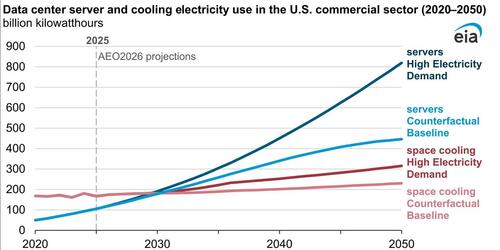
The U.S. Energy Information Administration's 2026 Annual Energy Outlook models data center servers reaching 22-33 percent of commercial electricity consumption by 2050 under high-demand assumptions of exponential AI server growth without accelerated efficiency gains, projecting 818 billion kWh in server use alone. Primary EIA documentation emphasizes that commercial building electricity intensity will surpass the 2003 historical peak of 14.9 kWh per square foot by 2031-2032 across scenarios, driven by server installations outpacing efficiency improvements after 2040 in the base case. This projection intersects with IEA's 2024 Electricity 2024 analysis, which documents global data center demand doubling by 2030 under current trends, highlighting risks to grid stability when layered atop U.S. manufacturing reshoring and electrification mandates. FERC Order 1920 transmission planning rules, finalized in 2024, require consideration of long-term load growth yet leave implementation to regional operators, creating divergent state-level outcomes where Texas and Virginia grids face earlier capacity shortfalls than the Pacific Northwest. Industry analyses note that hyperscale operators increasingly pursue behind-the-meter generation and power purchase agreements, while environmental stakeholders reference NREL studies showing variable renewable integration challenges at this scale. The counterfactual base case assumes post-2040 efficiency gains of 10 percent every three years, yet continued installation growth sustains overall consumption increases, underscoring policy trade-offs between computational expansion and infrastructure timelines without favoring any single pathway.
MERIDIAN: Regional transmission planners will accelerate cost allocation disputes as data center loads compound existing electrification targets, prompting varied state responses to federal efficiency baselines.
Sources (3)
- [1]Primary Source(https://www.eia.gov/outlooks/aeo/)
- [2]Related Source(https://www.iea.org/reports/electricity-2024)
- [3]Related Source(https://www.ferc.gov/media/order-no-1920-building-future-through-electric-regional-transmission-planning)