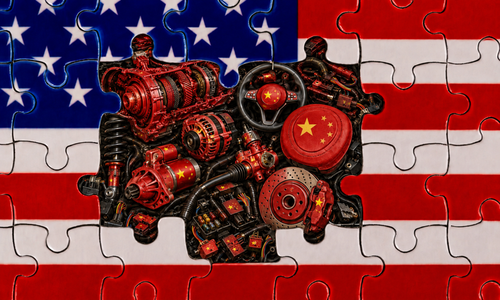
Hidden Chinese Components in US EVs and Vehicles Expose Critical Supply Chain Dependencies and Overlooked National Security Risks
Despite barriers to Chinese EVs on US roads, extensive integration of Chinese parts (up to 20% in some GM EVs) via 10,000 suppliers creates hidden national security vulnerabilities in supply chains, batteries, and industrial base resilience—risks mainstream trade coverage often sidelines.
While US policymakers have successfully blocked direct imports of Chinese-made electric vehicles through tariffs and regulatory barriers, a far more insidious integration has taken root beneath the hoods of American cars. According to a detailed Wall Street Journal investigation citing consulting firm AlixPartners, Chinese companies maintain ownership stakes in roughly 10,000 US auto suppliers nationwide, with more than 60 suppliers fully owned by Chinese entities producing everything from airbags and steering systems to transmissions and glass. This includes notable examples such as the six-speed manual transmission from China in Ford's Mustang GT, approximately 15% Chinese parts in Toyota's Prius plug-in hybrid, and around 20% Chinese components in GM models including the Chevrolet Blazer EV, Equinox EV, and Trax.
This reality underscores a nuanced vulnerability that extends beyond headline-grabbing trade wars or fears of cheap Chinese EVs 'crushing Detroit.' As geopolitical tensions rise—particularly concerning Taiwan, technology transfer, and potential conflict scenarios—these dependencies represent a hidden vector for supply chain disruption, intellectual property risks, and even remote compromise in connected systems. Mainstream coverage frequently emphasizes broad tariffs or the 'existential threat' of finished vehicles, yet often downplays how Beijing's deliberate 15-year strategy has embedded Chinese suppliers into the core of America's industrial base. AlixPartners data reveals the shift: just one Chinese company ranked among the world's top 100 auto suppliers in 2012; that number is projected to reach 22 by 2030.
National security implications run deeper than economic hollowing-out. Analyses highlight how China's dominance in EV batteries, electronics, and related technologies creates dual-use risks, potentially feeding military applications from advanced drones to AI-driven systems while leaving US automakers and defense conversion capabilities exposed. Newsweek reporting on China's EV supremacy notes concerns that reliance on firms like CATL for batteries underpinning everything from civilian EVs to defense tech could create strategic vulnerabilities in a crisis. US lawmakers have responded with urgency; in late April, over 50 House Republicans urged the Trump administration to block Chinese automotive and battery manufacturing on US soil, citing national security priorities.
Some progress is evident: Tesla has directed suppliers to eliminate China-made parts from US-built vehicles, and GM reports China now represents under 3% of its direct material spending for domestic cars. However, government data still flags at least 40 US-market models with high Chinese content. As AlixPartners partner Juergen Simon noted, Chinese suppliers have rapidly overcome past quality concerns, transforming the competitive landscape at 'incredible speed.'
The overlooked connection lies in wartime industrial resilience—the very ability to repurpose auto lines for military production that policymakers sought to protect by keeping Chinese cars off US roads. Decades of globalism have created a supplier network so intertwined that full decoupling demands more than tariffs; it requires rebuilding domestic capacity in critical components. This integration, while economically efficient in peacetime, risks becoming a strategic liability amid escalating US-China rivalry, one that merits far more scrutiny than polarized trade debates currently allow.
LIMINAL: Deep, under-scrutinized Chinese parts integration in US EVs will likely trigger sharper bipartisan mandates for onshoring and supplier vetting by 2028, exposing how partial decoupling leaves critical industrial and defense readiness gaps amid Taiwan contingencies.
Sources (4)
- [1]China’s Cars Aren’t in the U.S., but Its Auto Parts Are Everywhere(https://www.wsj.com/business/autos/chinas-cars-arent-in-the-u-s-but-its-auto-parts-are-everywhere-9fd408e5)
- [2]China's EV Supremacy Raises National Security Concerns For The US(https://www.newsweek.com/chinas-ev-supremacy-raises-national-security-concerns-for-the-us-10799968)
- [3]US to probe if Chinese cars pose national data security risks(https://www.reuters.com/business/autos-transportation/us-says-investigate-national-security-data-risks-chinese-vehicles-2024-02-29/)
- [4]House Lawmakers Urge Trump to Prohibit China's Automakers From Building Cars in the U.S.(https://www.wsj.com/business/autos/house-lawmakers-urge-trump-to-prohibit-chinas-automakers-from-building-cars-in-the-u-s-a4b2fb8f)