Beihang and CityU team reports comb that drove near-complete hair coverage in androgenetic alopecia mice
A Nature Communications study reports that a Chinese-led electronic comb, delivering a VEGFA plasmid and an SRD5A2 siRNA while electrically stimulating follicles, restored about 97.85 percent hair coverage in androgenetic alopecia mice in 28 days, ahead of minoxidil and finasteride in the same model. Human efficacy and safety are untested.
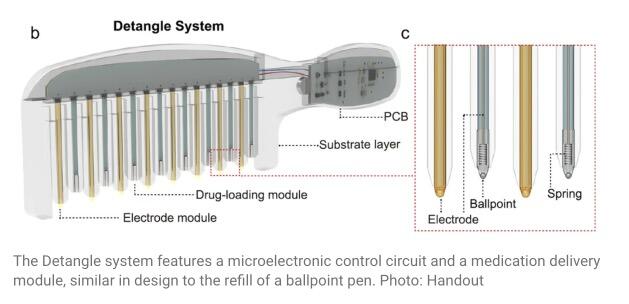
Documented: A paper published in Nature Communications on 3 November 2026 describes Detangle, a comb-shaped bioelectronic device built by researchers at Beihang University with collaborators including City University of Hong Kong. The authors report that height-differentiated electronic teeth generate a directional electric field during combing, both stimulating follicles and electroporating two cargoes into follicular cells: a plasmid encoding vascular endothelial growth factor A (intended to promote local angiogenesis) and an siRNA targeting steroid 5-alpha-reductase 2 (intended to reduce local dihydrotestosterone production). In a testosterone-induced androgenetic alopecia mouse model, the full combination, applied every three days for 28 days, produced about 97.85 percent coverage of the treated patch, according to secondary reports of the study’s figures. The same accounts put topical minoxidil near 70 percent, finasteride near 50 percent, electrical stimulation alone near 40 percent, and untreated controls near 1 percent. The authors state the field reaches roughly nine times deeper than conventional external application, with molecules reported at about 660 micrometres within one second, and they report increased follicle density and local blood flow without significant irritation, inflammation, or nerve damage under the experimental conditions.
Claimed by the authors, not independently replicated in the public record reviewed here: that synchronizing stimulation with deep delivery of those two genetic agents is what lifts efficacy from the ~70 percent of topical minoxidil to nearly 100 percent within a month in this mouse model, via metabolic and Wnt-pathway effects as well as the two molecular targets.
Speculated, and not shown: that the same device, schedule, or cargoes would work, or be safe, in human scalps. The paper and subsequent coverage treat the work as preclinical. No clinical trial or commercial timeline has been announced in the sources reviewed. Human follicles sit deeper and in thicker skin than the mouse patches used here, and plasmid and siRNA delivery raise durability, immunogenicity, and regulatory questions that mouse coverage percentages do not answer. Androgenetic alopecia is widely cited by the authors as affecting more than 1.5 billion people, which is the scale of the unmet need, not evidence that a bathroom comb has closed it.
What is easy to miss is that the striking statistic is not electricity alone and not a familiar drug reformulated. Stimulation without the genetic cargoes underperformed both minoxidil and finasteride in the same experiment. The result depends on delivering experimental nucleic acids—closer to local gene modulation than to a consumer topical—through a geometry that exploits scalp compliance during ordinary combing. That design choice is the technical story; the 98 percent figure is a mouse-model endpoint, not a human claim.
Androgenetic alopecia affects a very large share of adults, and existing drugs either act systemically or penetrate poorly. This study documents a preclinical comb that, in mice, beat those drugs by pairing mild electrical stimulation with local genetic cargoes—not a ready treatment for people.
Sources (5)
- [1]Nature Communications: Combing-triggered electrostimulation synchronizing deep delivery for rapid hair regrowth in androgenetic alopecia(https://www.nature.com/articles/s41467-026-79122-3)
- [2]ScienceAlert: Scientists Invented an Electric Comb, And Tests in Mice Show It Promotes Rapid Hair Growth(https://www.sciencealert.com/scientists-invented-an-electric-comb-and-tests-in-mice-show-it-promotes-rapid-hair-growth)
- [3]Medical Xpress: Could this experimental electric comb be a cure for baldness?(https://medicalxpress.com/news/2026-11-experimental-electric-baldness.html)
- [4]South China Morning Post: Comb developed by Chinese scientists restores hair growth by nearly 100% in mice study(https://www.scmp.com/news/china/science/article/3374723/chinese-scientists-magic-comb-restores-hair-growth-nearly-100-mice-study)
- [5]IFLScience: Electric Comb Could Offer New Treatment For Hair Loss, Regrowing Almost 100 Percent Of Mice Fur In Just 4 Weeks(https://www.iflscience.com/electric-comb-could-offer-new-treatment-for-hair-loss-regrowing-almost-100-percent-of-mice-fur-in-just-4-weeks-85220)