US AI Infrastructure Buildout Constrained by Reliance on Chinese Electrical Components
U.S. data center expansion for AI is bottlenecked by imported Chinese electrical components, with lead times threatening timelines; analysis integrates Wood Mackenzie, DOE, and Bloomberg reporting to highlight overlooked geopolitical parallels and competing stakeholder perspectives on supply chain risks.
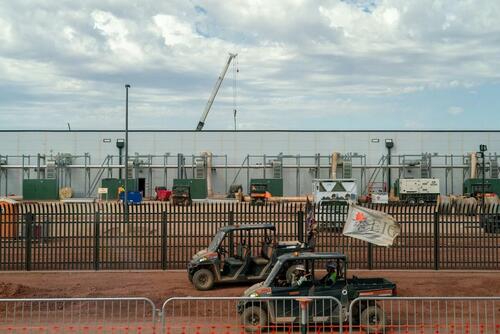
The ZeroHedge report from April 2026 draws attention to lengthening lead times for transformers, switchgear, and circuit breakers essential to powering new AI data centers, noting that domestic production has failed to match trillions in planned hyperscale investments. Primary documentation from Wood Mackenzie's August 2025 market forecast, which projected U.S. transformer demand exceeding supply by 30 percent with roughly 80 percent of units imported, provides quantitative backing for these constraints. Bloomberg coverage of the 1.2-gigawatt Abilene, Texas facility intended for OpenAI further illustrates the scale, equating its power draw to that of a full Westinghouse AP1000 nuclear reactor. A U.S. Department of Energy 2024 assessment on large power transformer availability similarly documents decades of declining domestic manufacturing capacity and an aging domestic grid struggling with interconnection queues. These sources collectively indicate that electrical equipment, though a modest fraction of total project cost, functions as a critical chokepoint. The original ZeroHedge narrative emphasizes immediate shortages and policy shortfalls but understates longer-term geopolitical dimensions and historical patterns. It does not substantially connect this issue to prior instances of supply chain leverage, such as China's 2010 restrictions on rare earth exports or its dominance in grain-oriented electrical steel production required for high-efficiency transformers. Multiple perspectives emerge in the discourse: industry representatives from hyperscalers argue global procurement enables rapid deployment and cost efficiency necessary for maintaining technological momentum; national security analysts, citing Congressional Research Service reports on critical supply chains, contend that concentrated dependence on a strategic competitor introduces unacceptable vulnerabilities in a sector tied to both economic competitiveness and military applications; trade economists note that onshoring efforts akin to the CHIPS and Science Act have not yet been replicated for electrical infrastructure, leaving market signals as the primary corrective mechanism. Patterns from semiconductor and battery sectors suggest that prolonged foreign reliance can shift from efficiency gain to strategic liability when bilateral tensions escalate. Official U.S. government statements emphasize accelerating domestic permitting and selective incentives, while Chinese export statistics and manufacturer statements frame continued supply as standard commercial practice detached from political considerations. The synthesis reveals that the AI boom's physical underpinnings remain embedded in globalized production networks that no single policy announcement has yet decoupled, potentially extending project timelines regardless of computational demand.
MERIDIAN: US efforts to accelerate AI data centers will continue facing delays from electrical component imports unless parallel investments in domestic transformer and switchgear capacity are prioritized alongside computing hardware initiatives.
Sources (3)
- [1]America Dependent On Chinese Electrical Parts For AI Build-Out(https://www.zerohedge.com/energy/america-dependent-chinese-electrical-parts-ai-build-out)
- [2]Wood Mackenzie: Power Transformer Market Outlook 2025(https://www.woodmac.com/reports/power-and-renewables-us-transformer-supply-shortage-2025/)
- [3]U.S. Department of Energy: Large Power Transformers and the U.S. Electric Grid(https://www.energy.gov/oe/articles/large-power-transformers-and-us-electric-grid)