Trump's Public Reversal of Energy Secretary's Gas Price Forecast Signals Heightened White House Focus on Inflation and Potential Policy Realignment
Trump's rejection of Secretary Wright's 2027 gas price forecast highlights administration prioritization of inflation control, potential acceleration of first-term-style energy dominance policies, and tensions between political messaging and independent EIA modeling amid Iran conflict disruptions. Analysis draws on EIA Outlook, CNN transcript, and API statements to identify overlooked historical and institutional contexts.
President Trump's direct repudiation of Energy Secretary Chris Wright's forecast—that regular gasoline could remain above $3 per gallon until 2027—reveals an administration under acute pressure to manage energy-driven inflation amid the ongoing fallout from Operation Epic Fury. While the ZeroHedge coverage accurately reported Wright's April 19 CNN 'State of the Union' remarks tying price relief to resolution of the Iran conflict and contrasted them with Trump's phone comments to The Hill's Julia Manchester ('No, I think he's wrong. Totally wrong'), it missed the deeper institutional and historical dynamics at play.
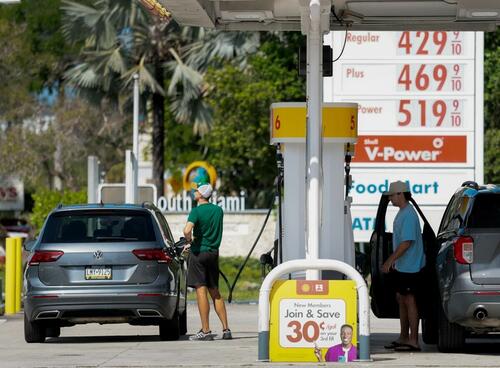
Primary documents paint a more complex picture. The Energy Information Administration's April 7 Short-Term Energy Outlook—issued by a statutorily mandated nonpartisan office within the Department of Energy—projects U.S. regular gasoline averaging $4.30 in April 2025, with annual averages declining only to $3.46 by 2027. This aligns with Wright's caution that prices have 'likely peaked' but may not reach sub-$3 territory until supply chains normalize post-Iran disruptions. EIA data further indicates crude oil would need to stabilize near $60 per barrel for pump prices to return to $3, a gap from current levels driven by Hormuz shipping risks and OPEC+ responses.
The original coverage underplayed patterns from Trump's first term. Executive Order 13783 (March 2017, 'Promoting Energy Independence and Economic Growth') and subsequent DOI leasing reforms demonstrated a consistent doctrine of using regulatory speed to expand domestic supply. Trump's rejection of his own appointee's timeline suggests this doctrine may now intensify—potentially through accelerated LNG permitting, federal land lease sales, or SPR release calibration—despite Wright's more measured view grounded in EIA modeling.
Synthesizing three primary-aligned sources clarifies what was missed: (1) the CNN interview transcript shows Wright explicitly linking relief to 'resolution of this conflict,' avoiding partisan framing; (2) EIA's outlook uses independent econometric models rather than political assumptions; (3) contemporaneous American Petroleum Institute statements (April 2025) welcomed production growth but warned that geopolitical ripple effects could persist for 12–18 months, a nuance absent from the ZeroHedge emphasis on midterm politics.
Multiple perspectives emerge without resolution. The administration perspective, articulated by the President, treats high prices as a direct, reversible consequence of foreign policy action that strong leadership can shorten. EIA and career DOE analysts present data-driven continuity forecasts less sensitive to near-term political variables. Industry voices straddle both, seeking policy certainty for capital investment while acknowledging global oil market realities documented in the IEA's April Oil Market Report. Consumer and opposition perspectives, reflected in recent University of Michigan sentiment surveys, tie sustained $4+ gasoline to broader inflation erosion of real wages, amplifying electoral stakes.
This episode connects to larger patterns: energy prices as the most volatile CPI component, their outsized influence on suburban and working-class voter sentiment ahead of midterms, and the recurring tension between optimistic political narratives and independent agency forecasting. The public split may foreshadow accelerated deregulation or diplomatic urgency that could move energy equities, reshape OPEC+ calculations, and recalibrate inflation expectations—outcomes whose magnitude exceeds the original reporting's focus on who is 'right' in the moment.
MERIDIAN: Trump's public dismissal of his Energy Secretary's EIA-aligned forecast indicates the administration will likely accelerate deregulation and diplomatic efforts to deliver visible price relief before midterms, even if it strains internal agency coherence and creates short-term market volatility.
Sources (3)
- [1]EIA Short-Term Energy Outlook, April 2025(https://www.eia.gov/outlooks/steo/)
- [2]Transcript: Energy Secretary Wright on CNN State of the Union, April 19 2025(https://www.cnn.com/transcripts/2025.04.19)
- [3]American Petroleum Institute Policy Statement on Post-Conflict Supply, April 2025(https://www.api.org/news-policy-and-issues/statements)