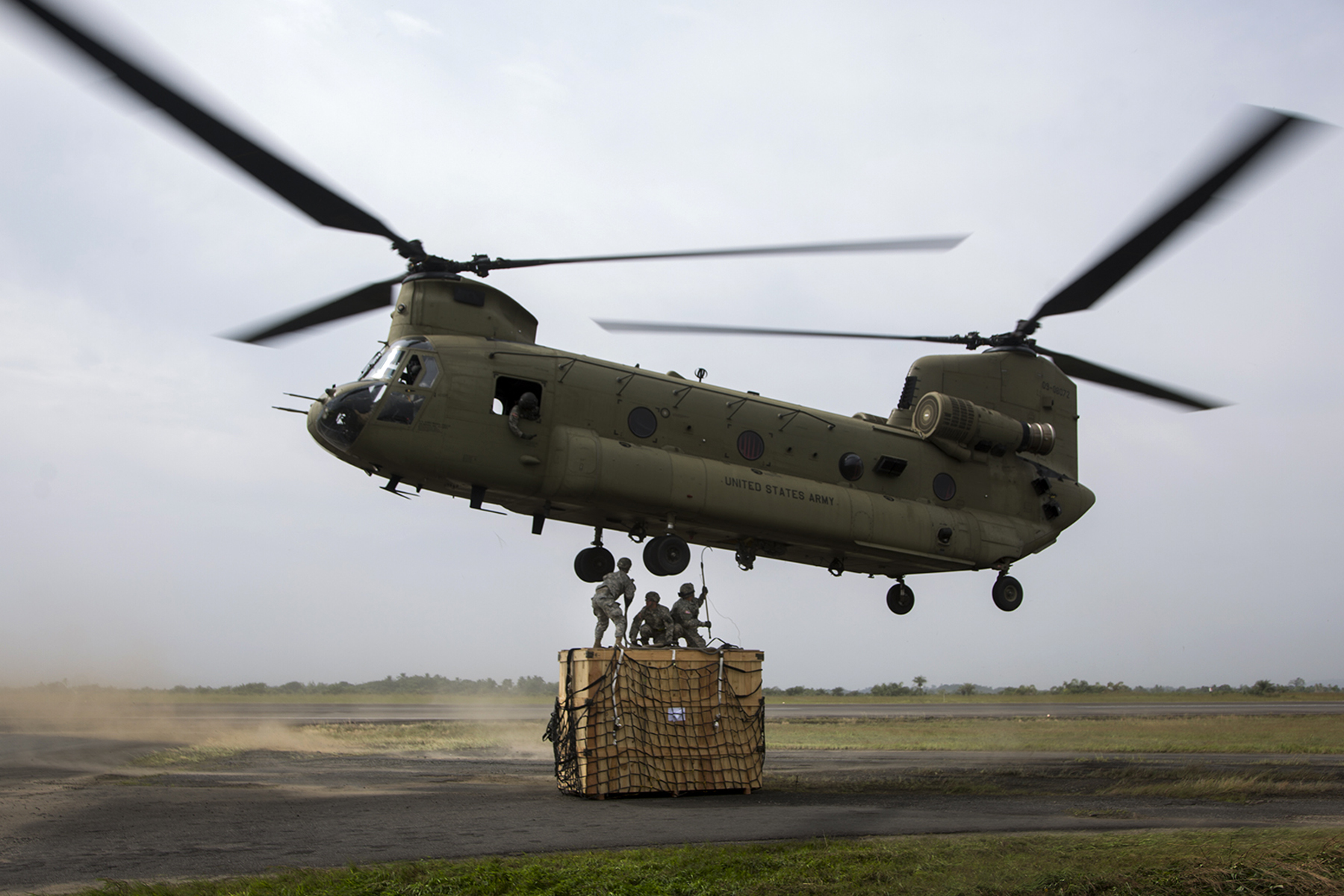
Autonomous Chinook: Boeing's Pilotless Landing Accelerates Shift in Contested Logistics and Risk Calculus
SENTINEL analysis shows Boeing's autonomous Chinook landing is a strategic inflection point in military autonomy, poised to transform Army logistics and risk profiles in A2/AD environments like the Pacific theater by enabling crew-optional heavy-lift operations while exposing new EW and cyber vulnerabilities the original reporting largely overlooked.
Boeing's successful autonomous landing of a U.S. Army CH-47 Chinook using its Approach-to-X (A2X) software represents far more than an incremental avionics upgrade. While the Defense News report correctly notes the system's precision (sub-five-foot average error across 150 approaches) and its immediate benefit of reducing pilot workload during vulnerable terminal phases, it largely misses the deeper strategic transformation underway. This demonstration is a tangible marker of accelerating military autonomy that will reshape logistics networks, recalibrate risk profiles for aircrews, and alter operational art in contested environments, particularly across the Indo-Pacific.
The original coverage frames A2X primarily as a human-factors improvement, allowing crews to maintain "eyes-out awareness" in tactical situations. What it understates is the deliberate convergence with parallel Army programs: the recent delivery of the fly-by-wire H-60Mx Black Hawk configured for optional piloting, the Future Long-Range Assault Aircraft (FLRAA) MV-75 tiltrotor optimized for Pacific distances, and legacy DARPA ALIAS efforts to retrofit existing airframes with ghost-pilot autonomy. Synthesizing these with a 2023 RAND Corporation analysis on "Unmanned Aircraft Systems and Autonomy in Army Aviation" and Lockheed Martin's publicly documented 2022 MATRIX autonomy flights on Black Hawks reveals a clear trajectory: from pilot-assisted approaches to optionally-manned, then fully unmanned heavy-lift resupply in denied airspace.
This matters because traditional rotary-wing logistics have historically been constrained by crew risk during hover, sling-load operations, and landing in contested terrain. In a Taiwan or South China Sea scenario, Chinese integrated air-defense systems and long-range precision fires would render predictable helicopter landing zones extremely hazardous. Autonomous capability fundamentally changes that risk equation. Commanders could push heavy equipment, ammunition, and medical supplies deeper into contested zones without sacrificing aircrew lives, enabling distributed operations and reducing the logistical tail that has historically limited maneuver.
However, genuine analysis must acknowledge what the coverage glossed over: new vulnerabilities. A2X and similar systems remain susceptible to sophisticated electronic warfare, GPS denial, and adversarial machine-learning attacks that could spoof or hijack guidance. The Army's own Future Vertical Lift program documents acknowledge that autonomy must be paired with resilient communications and onboard decision-making AI. Furthermore, while Boeing emphasizes pilot override options, the long-term pattern across DoD programs (CCAs, MQ-25, Army's robotic combat vehicles) points toward humans moving from direct control to supervisory roles, then to exception handling only.
The broader pattern is clear. Autonomy is not merely force protection; it is force multiplication. It allows sustained tempo in attritional fights where pilot fatigue and casualty aversion have historically imposed operational pauses. In peer conflict, the side that can autonomously maintain supply lines under fire will hold decisive advantage. Boeing's test, though technically modest, is thus a harbinger of doctrinal change: logistics as a persistent, low-signature autonomous domain rather than episodic manned missions. The Army must now accelerate supporting infrastructure, including AI mission planners and hardened datalinks, to realize this potential before competitors close the gap.
SENTINEL: Boeing's pilotless Chinook capability marks the acceleration of military autonomy that will allow sustained heavy-lift logistics in high-threat A2/AD environments. This will lower risk thresholds for commanders, enable deeper penetration into contested areas, and force adversaries to invest heavily in counter-autonomy systems, reshaping Pacific conflict dynamics within the next decade.
Sources (3)
- [1]Boeing lands Chinook without a pilot at the controls(https://www.defensenews.com/news/your-military/2026/04/20/boeing-lands-chinook-without-a-pilot-at-the-controls/)
- [2]Unmanned Aircraft Systems and Autonomy in Army Aviation(https://www.rand.org/pubs/research_reports/RRA1656-1.html)
- [3]MATRIX Autonomy Flies On Black Hawk(https://www.lockheedmartin.com/en-us/news/features/2022/autonomous-black-hawk.html)