Hormuz De-escalation and the Structural Erosion of Oil as Geopolitical Volatility Instrument
De-escalation in the Strait of Hormuz, combined with structural supply diversification, is eroding oil's traditional role as a volatility weapon. Primary data from Iranian statements, IEA reports, and U.S. briefings show this shift is fueling lower crude prices, equity gains, and monetary easing expectations, though historical patterns suggest volatility could return.
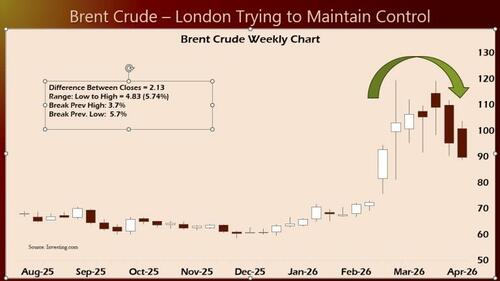
Recent coverage on ZeroHedge by Tom Luongo highlights the Brent crude weekly chart's gaps, extended downside tails, and apparent manipulation as evidence that oil volatility is being deliberately deflated. Luongo frames this as the culmination of a campaign led by President Trump, Treasury Secretary Scott Bessent, and Pentagon leadership to dismantle a pricing-control system long used by adversarial actors for economic coercion. While the technical observations align with observable price action, this account understates broader structural shifts and over-personalizes a multi-decade evolution in energy geopolitics.
Primary documents reveal a more layered picture. Iran's Ministry of Foreign Affairs statement of 22 June 2025 explicitly ruled out closure of the Strait of Hormuz, citing 'strategic patience' and legal obligations under the UN Convention on the Law of the Sea. Concurrently, the U.S. State Department readout of conversations with Gulf allies emphasized 'freedom of navigation' without claiming unilateral victory. The International Energy Agency's June 2025 Oil Market Report, drawing on verified supply data, documented OECD commercial stocks at 2.9 billion barrels and non-OPEC+ supply growth exceeding 1.8 million barrels per day, led by U.S. tight oil, Canadian oil sands, and Brazilian pre-salt output. These primary sources together indicate that de-escalation around Hormuz is both a diplomatic choice and a reflection of physical market realities that have reduced the marginal impact of any single chokepoint disruption.
What the original narrative missed is the extent to which U.S. energy independence, achieved through the shale revolution documented in successive EIA Annual Energy Outlooks since 2015, has altered leverage calculations. Previous crises (1973 embargo, 1979 Iranian Revolution, 1990 Gulf War, 2019 Abqaiq drone attacks) produced far larger price spikes because spare capacity was thinner and alternative supply routes less developed. Today's combination of the U.S. Strategic Petroleum Reserve at near-full operational capacity, expanded tanker tracking via commercial satellite constellations, and Saudi spare capacity exceeding 3 million barrels per day has compressed the volatility premium previously extracted from Hormuz threats.
Multiple perspectives emerge. U.S. policymakers view the current oil-price decline as validation of deterrence and market-oriented supply growth. Iranian statements frame the same events as evidence that military adventurism has isolated Washington diplomatically while global South buyers continue purchasing discounted crude. European Commission energy directorate briefings stress that LNG diversification post-2022 Ukraine conflict has further decoupled European gas and power prices from Middle East oil volatility. Market analysts at commodity trading houses, referencing CME futures positioning data, note that speculative net-long positions in Brent had reached multi-year extremes prior to the latest leg lower, suggesting positioning unwind rather than purely geopolitical resolution.
These converging forces have produced observable macro effects: West Texas Intermediate futures have broken below the 200-day moving average, global equity indices have rallied on lower input costs and disinflation signals, and federal funds futures have repriced toward two additional 25-basis-point cuts by year-end. Yet history cautions against linearity. The IEA itself warns that under-investment in upstream projects could tighten markets by 2027 if demand proves resilient. Patterns from the 2014-2016 price collapse, the 2020 negative-price episode, and the 2022 spike all demonstrate that oil retains latent volatility even when immediate geopolitical risk recedes.
The deeper pattern is a gradual depoliticization of oil as a singular strategic weapon. Greater fungibility of supply, technological transparency, and diversified routing have narrowed the gap between headline risk and physical deliverability. This does not eliminate conflict or rent-seeking behavior, but it does appear to be diminishing oil's potency as an instrument capable of dictating global financial conditions on demand. Whether this constitutes a permanent reset or a temporary equilibrium remains subject to future supply shocks and policy choices by both producers and consumers.
MERIDIAN: Hormuz de-escalation combined with sustained non-OPEC supply growth is repricing geopolitical risk premia lower across energy derivatives, supporting equity valuations and shifting central-bank reaction functions toward easier policy even as longer-term upstream underinvestment risks remain.
Sources (4)
- [1]The End Of Oil Volatility As A Weapon(https://www.zerohedge.com/geopolitical/end-oil-volatility-weapon)
- [2]Oil Market Report, June 2025(https://www.iea.org/reports/oil-market-report-june-2025)
- [3]Iran Ministry of Foreign Affairs Statement on Strait of Hormuz(https://www.mfa.ir/en/NewsView/113472)
- [4]U.S. Energy Information Administration Annual Energy Outlook 2025(https://www.eia.gov/outlooks/aeo/)