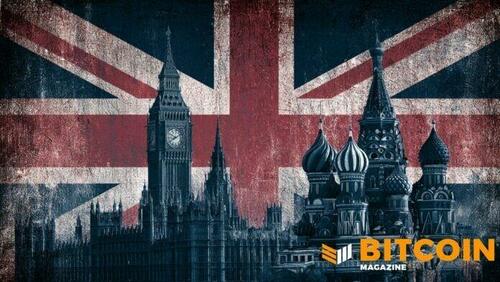
UK's A7 Crypto Sanctions Mark Quiet Expansion of Financial Warfare into Digital Assets
UK sanctions on the Kremlin-linked A7 crypto network and 18 related entities reveal the accelerating weaponization of digital assets in sanctions enforcement. While officials tout disruption of $90B+ in evasion flows tied to Russia's war machine, the episode highlights an underreported evolution: crypto as both a sanctions bypass tool and a new frontier of perpetual financial-technological escalation, with implications far beyond the Russia-Ukraine theater.
The United Kingdom's latest sanctions package, announced on May 26, 2026, targets the Kremlin-backed A7 network and associated cryptocurrency infrastructure, underscoring a significant evolution in how nations wage economic conflict. According to the official UK government statement, the measures designate 18 individuals and entities, including a major global crypto exchange suspected of channeling over $1.5 billion to Kremlin-linked parties, a Kyrgyz bank facilitating A7 flows, and three Georgian firms operating Russia-focused trading platforms. The A7 system, which issues a ruble-backed token known as A7A5, is described as having moved more than $90 billion in the past year—roughly half of Russia's annual military expenditure—by leveraging offshore routes through Central Asia and the Caucasus to sustain its war economy. This builds directly on prior actions, such as the 2025 designation of A7 LLC itself.
While mainstream coverage frames these moves as routine enforcement against sanctions evasion, a deeper examination reveals an underplayed pattern: the rapid integration of digital assets into state-level financial warfare. Russia has systematically replaced severed SWIFT and traditional banking links with stablecoin and token-based settlement systems, often routed through nominally independent platforms in Kyrgyzstan, Georgia, and the UAE. Blockchain analytics firms have traced these flows to sanctioned oligarchs, defense contractors tied to Promsvyazbank, and oil export revenues. This adaptation persists even as Russia's own Economy Ministry downgraded its 2026 growth forecast to just 0.4% from 1.3%, admitting the cumulative weight of restrictions.
Connections often missed in broader Russia-Ukraine reporting include the precedent this sets for future conflicts. By sanctioning not only obscure regional exchanges but also high-volume global players like HTX (formerly Huobi), Western powers are effectively compelling the entire crypto industry to enforce geopolitical compliance. Yet the very existence of A7—claiming near-military-budget scale in transaction volume—demonstrates the resilience of decentralized and pseudo-decentralized rails against coordinated state pressure. Mainstream narratives emphasize the $450 billion allegedly stripped from Russia's economy since 2022 (equivalent to two years of war funding) and Britain's tally of over 3,300 designations. They less frequently highlight how crypto's programmable, borderless nature is transforming sanctions from blunt instruments into an ongoing technological arms race, one likely to be studied and replicated by Iran, China, and other actors facing similar containment strategies.
Foreign Secretary Yvette Cooper stated that if the Kremlin believes it can hide behind crypto networks and shadow systems, it is 'gravely mistaken,' pledging continued collaboration with allies to dismantle these lifelines. However, the pattern suggests escalation rather than resolution: each new layer of digital financial controls prompts further innovation in privacy-enhancing tools, alternative blockchains, and non-Western settlement platforms. As financial warfare expands into on-chain territories, the distinction between neutral technology and strategic infrastructure dissolves. This episode with the A7 network is not an isolated enforcement action but a visible marker of hybrid conflict shifting into the digital realm, where traditional reporting often lags behind the technological reality.
[LIMINAL]: Sanctioning crypto networks like A7 normalizes digital assets as core terrain in great-power financial conflict, likely spurring more sophisticated decentralized evasion methods and accelerating a fragmented, multipolar monetary order.
Sources (5)
- [1]UK cracks down on backdoor Russian sanctions evasion with tough new measures(https://www.gov.uk/government/news/uk-cracks-down-on-backdoor-russian-sanctions-evasion-with-tough-new-measures)
- [2]UK targets Russian crypto networks in latest sanctions(https://www.reuters.com/world/uk-targets-russian-crypto-networks-latest-sanctions-2026-05-26/)
- [3]UK Sanctions Crypto Companies With Russia Ties(https://www.chainalysis.com/blog/uk-sanctions-crypto-entities-russian-trade-blockade-evasion-may-2026/)
- [4]UK Targets Russian Crypto Sanctions Evasion Network(https://www.occrp.org/en/news/uk-targets-russian-crypto-sanctions-evasion-network)
- [5]UK designates cryptoasset exchanges including HTX in sweeping new sanctions package(https://www.elliptic.co/blog/uk-designates-cryptoasset-exchanges-in-sweeping-new-sanctions-package)