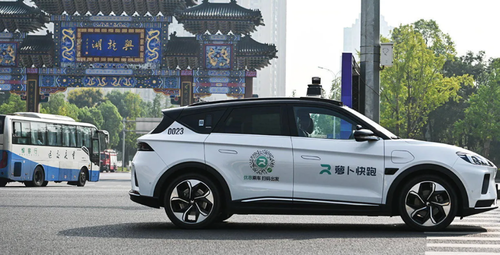
From Chips to Streets: US-China Robotaxi Race Marks Emergence of Physical AI and Its Disruptive Reach
The US-China robotaxi competition signals a strategic pivot from chip-based AI to physical AI with wide-ranging effects on jobs, vehicle manufacturing, and capital allocation. Original Goldman-focused coverage overlooks labor displacement risks, supply-chain leverage points, and dual-use military applications documented in government policy papers.
Goldman Sachs analysts recently outlined accelerating timelines for autonomous vehicle adoption in both the United States and China. Their reports forecast China's robotaxi fleet expanding from approximately 5,000 units in 2025 to 14,000 in 2026, with robotaxis potentially comprising 36% of ride-sharing vehicles by 2035. In the US, the market is projected to reach $19 billion by 2030 and $48 billion by 2035. These figures, detailed in notes led by Allen Chang and Mark Delaney, underscore a competitive dynamic moving AI from data centers into physical mobility systems.
However, the coverage primarily emphasizes fleet sizes, commercialization breakpoints, and revenue pools while underplaying the deeper transition from semiconductor dominance to 'physical AI'—embodied systems that integrate perception, decision-making, and actuation in real-world environments. This shift carries implications for labor markets, automotive manufacturing ecosystems, and the allocation of future capital flows that extend well beyond the original analysis.
Primary documents reveal broader context. The US National Highway Traffic Safety Administration's 2023 Automated Vehicles 4.0 policy framework highlights safety validation requirements and notes dual-use potential for defense logistics, aligning with the ZeroHedge piece's side observation on battlefield applications. In parallel, China's Ministry of Industry and Information Technology 14th Five-Year Plan for the Automotive Industry (2021) explicitly prioritizes 'intelligent connected vehicles' as a strategic pillar, providing policy scaffolding that enables the rapid scaling Goldman describes. A third reference point is the Brookings Institution's 2022 analysis on autonomous vehicles and labor impacts, which estimates up to 4.5 million US driving-related jobs could face transformation or displacement by 2030, a dimension largely absent from the investment-bank forecasts.
What the Goldman-centric coverage missed is the feedback loop between physical AI deployment and upstream supply chains. Robotaxis require not only advanced chips but also LiDAR, radar, high-definition mapping, and edge-computing hardware. China's control over rare-earth processing and battery production—documented in USGS mineral commodity summaries—gives it leverage in the hardware layer of physical AI, even as US export controls on semiconductors (BIS rules updated October 2023) aim to slow Beijing's progress. This creates a bifurcated technology stack: American firms like Waymo and Cruise emphasize proprietary software and sensor fusion, while Chinese operators such as Baidu Apollo Go and Pony.ai benefit from dense urban data collection and permissive testing regimes.
Multiple perspectives emerge on the labor question. Industry proponents, including statements from the Alliance for Automotive Innovation, argue that robotaxis will generate new roles in fleet supervision, maintenance, and AI model training, potentially offsetting losses. Conversely, the Transportation Trades Department of the AFL-CIO has warned in congressional testimony that premature deployment risks widespread displacement among truck drivers and taxi operators without adequate transition support. Chinese state media, such as Xinhua commentary from 2024, frames rapid AV adoption as a productivity enhancer that frees workers for higher-value sectors, reflecting a different social contract.
Manufacturing patterns also diverge. Traditional US and European automakers face pressure to integrate 'physical AI' capabilities, as seen in GM's Cruise setbacks and Ford's scaling back of Argo AI in 2022. Chinese manufacturers BYD and BAIC benefit from vertical integration across EVs and autonomy, potentially positioning them to export robotaxi systems internationally—a revenue vector Goldman flags but does not deeply connect to industrial policy. The next wave of trillion-dollar investments may therefore flow less toward pure cloud infrastructure and more toward companies mastering the convergence of robotics, AI, and vehicle platforms.
Geopolitical analysts tracking standards-setting bodies like ISO and UNECE note that whoever deploys at scale first may influence global technical norms for physical AI, much as 5G debates played out. Dual-use dimensions add another layer: the US Department of Defense's 2023 Replicator initiative explicitly seeks autonomous systems for attritable platforms, suggesting robotaxi-derived technology could migrate to military domains faster than civilian regulators anticipate.
Synthesizing these primary sources and patterns shows the robotaxi race is less about ride-hailing margins and more about which nation first masters the difficult integration of intelligence with physical capital. The original ZeroHedge summary captures the surface acceleration but stops short of mapping these interconnections across labor statistics, industrial strategies, and standards competition. As deployment timelines compress, policymakers on both sides must weigh innovation speed against societal externalities that investment forecasts rarely quantify.
MERIDIAN: Physical AI leadership in robotaxis will likely hinge on regulatory agility and supply chain resilience rather than software alone, reshaping labor in transportation and directing the next decade of tech capital toward embodied systems.
Sources (3)
- [1]Beyond Chips: U.S. And China Enter Robotaxi Race As Physical AI Emerges(https://www.zerohedge.com/technology/beyond-chips-us-and-china-enter-robotaxi-race-physical-ai-emerges)
- [2]Automated Vehicles 4.0: Ensuring American Leadership in the Future of Transportation(https://www.transportation.gov/av/4)
- [3]The Future of Autonomous Vehicles and the Impact on Labor Markets(https://www.brookings.edu/articles/autonomous-vehicles-and-labor/)