Zinc Batteries and the Undercovered Storage Shift Powering AI Infrastructure
Zinc-based stationary storage is gaining traction as a lithium alternative amid surging AI data center demand, revealing a deeper geopolitical and policy-driven shift toward supply-chain security and domestic manufacturing that mainstream coverage has largely overlooked.
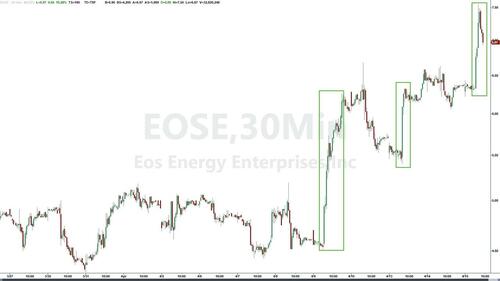
The sharp rise in Eos Energy Enterprises shares, as detailed in ZeroHedge's aggregation of International Business Times reporting, centers on the company's preliminary Q1 2026 revenue guidance of $56–57 million, improved manufacturing efficiency in Pennsylvania, and a $701 million backlog. While the coverage correctly notes zinc batteries' positioning as safer and more domestically sourced than lithium-ion for utility-scale and data center applications, it stops short of examining the deeper structural transition underway.
Primary documents reveal the stakes. The U.S. Geological Survey's Mineral Commodity Summaries 2024 records that lithium processing remains over 60% concentrated in China, creating precisely the supply-chain vulnerability the Inflation Reduction Act of 2022 (Public Law 117-169) was written to mitigate through domestic content bonuses and loan guarantees. Zinc, by contrast, draws on abundant North American reserves and established smelting capacity outside adversarial control. This is not incidental but a deliberate policy lever now intersecting with AI-driven electricity demand.
The IEA's Electricity 2024 report projects U.S. data centers could double their power consumption by 2030, potentially requiring hundreds of gigawatts of flexible storage to balance both intermittent renewables and always-on computing loads. Lithium-ion systems, optimized for mobility, carry thermal runaway risks that complicate dense hyperscale deployments—an engineering reality acknowledged in National Fire Protection Association standards but rarely linked in financial journalism to stationary storage alternatives.
What original coverage missed is the convergence pattern: AI capex is accelerating a battery technology diversification already quietly incentivized by Department of Energy programs and Defense Production Act priorities for critical materials. Eos's aqueous zinc technology, unlike earlier zinc-bromine flow batteries, targets simpler manufacturing scalable within existing U.S. industrial footprints. This mirrors parallel moves by ESS Inc. and Form Energy on iron-air systems—collectively signaling investors and policymakers are hedging against lithium price volatility and geopolitical chokepoints.
Multiple perspectives exist without resolution. Technology executives at hyperscalers emphasize safety and 24/7 carbon-free power contracts; utility planners prioritize long-duration discharge profiles where zinc chemistry holds advantages; national security analysts highlight reduced exposure to concentrated mineral supply chains. Counter-views note zinc batteries' lower round-trip efficiency and energy density compared with lithium, though these metrics matter less for stationary, grid-tied assets than for vehicles. Execution risk remains material—Eos has faced class-action litigation over prior revenue guidance, underscoring that operational scaling, not merely chemistry, will determine outcomes.
Synthesizing these threads, the zinc momentum represents an undercovered energy storage regime shift. AI infrastructure growth will test grid and material limits simultaneously; technologies that can be manufactured domestically at competitive cost while satisfying safety and duration requirements therefore carry strategic weight beyond quarterly revenue beats. Whether Eos or its peers successfully convert backlog into profitable deployments will help decide if U.S. tech expansion remains constrained by imported battery chemistry or gains a more resilient domestic foundation.
MERIDIAN: Zinc batteries are moving from niche to strategic asset class as AI power demand collides with lithium supply risks; sustained policy support and proven scale-up could materially alter critical minerals dependencies within five years.
Sources (3)
- [1]Eos Energy Soars As Investors Focus On Zinc Batteries And AI-Driven Demand(https://www.zerohedge.com/markets/eos-energy-spikes-16-investors-focus-zinc-batteries-and-ai-driven-demand)
- [2]Electricity 2024(https://www.iea.org/reports/electricity-2024)
- [3]Mineral Commodity Summaries 2024(https://pubs.usgs.gov/periodicals/mcs2024/mcs2024.pdf)