China's Rare Earth Dominance Persists: Western Supply Chain Efforts Face Decades-Long Hurdles
China's rare earth chokehold, rooted in processing and magnet dominance, is unlikely to be broken this decade despite US and allied investments; IEA data confirms structural gaps persisting to 2035, with MP Materials' progress highlighting both advances and limitations amid export controls and geopolitical friction.
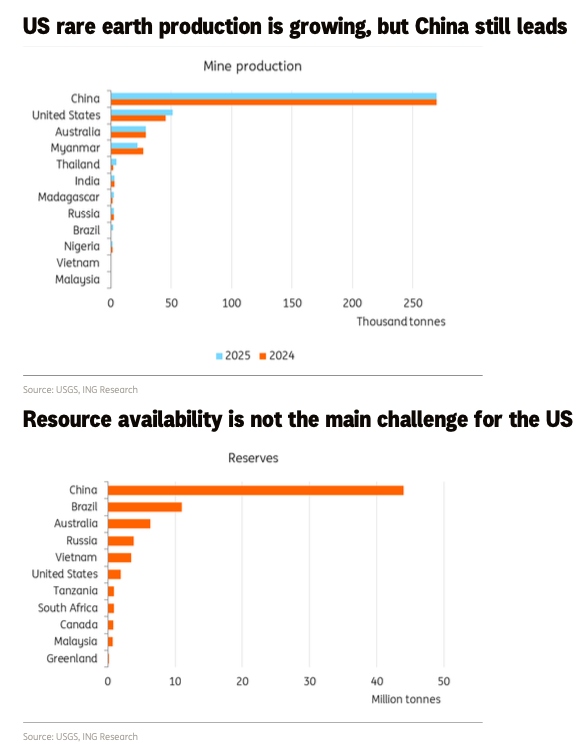
China maintains a commanding position in the rare earth supply chain, accounting for approximately 60% of global mined magnet rare earths, 91% of refined output, and 94% of permanent magnet production, according to the International Energy Agency (IEA). This concentration extends beyond mining into critical downstream stages like processing, heavy rare earth separation, and magnet manufacturing, creating persistent vulnerabilities for Western industries reliant on these materials for EVs, defense, aerospace, and renewables.
The IEA's Global Critical Minerals Outlook highlights that even with announced projects outside China, capacity would meet well below 20% of ex-China magnet demand by 2035, requiring a six-fold expansion in magnet production and four-fold in refining to close gaps. Announced non-Chinese magnet projects total around 18,000 tons annually—far short of needs. Heavy rare earths like dysprosium and terbium, essential for high-temperature magnet performance, remain particularly constrained due to production concentration in China and Myanmar.
In the US, MP Materials has made tangible progress, achieving record output of over 50,000 tons of rare earth oxide concentrate in 2025 and initiating commercial neodymium-iron-boron (NdFeB) magnet production at its Texas facilities. Expansions, including a new $1.25 billion campus, aim to scale capacity significantly. Federal support includes grants, loans, equity stakes, and long-term purchase commitments. Similar efforts in Australia and Brazil, plus recycling initiatives, are underway. However, analysts from ING and Barclays note that industrial bottlenecks—not geology—define the challenge, with full diversification unlikely before the 2030s.
Geopolitical tensions exacerbate risks. China's 2025 export controls on heavy rare earths and related technologies have disrupted supplies, driving up ex-China prices and prompting US responses like restrictions on jet parts exports. The IEA warns that full implementation of curbs could endanger $6.5 trillion in downstream Western production. While US output has grown, reliance on Chinese imports is projected to continue into the 2030s, underscoring supply chain resilience gaps amid rearmament and energy transition demands.
Broader connections reveal systemic issues: decades of offshoring processing due to costs and regulations left the West dependent, while China's state-backed scale created self-reinforcing advantages. Investment needs for diversification are estimated at $60 billion annually over the next decade, focused on midstream stages.
ING Analysts: Persistent downstream bottlenecks will keep Western defense and EV sectors exposed to Chinese leverage through at least 2030, driving accelerated but incomplete friendshoring and higher costs.
Sources (6)
- [1]Rare earth elements 2025 – Analysis(https://www.iea.org/reports/rare-earth-elements-2025)
- [2]Executive summary – Rare Earth Elements(https://www.iea.org/reports/rare-earth-elements/executive-summary)
- [3]China's rare earths dominance to overshadow Trump's talks with Xi(https://www.reuters.com/world/china/chinas-rare-earths-dominance-overshadow-trumps-talks-with-xi-2026-09-24/)
- [4]Why the US rare earth supply chain remains vulnerable(https://think.ing.com/articles/hold-for-monday-article-1-why-the-us-rare-earth-supply-chain-remains-vulnerable/)
- [5]MP Materials Selects Northlake, Texas, as the Site of “10X,”(https://mpmaterials.com/news//mp-materials-selects-northlake-texas-as-the-site-of-10X-a-new-us-rare-earth-magnet-manufacturing-campus/)
- [6]China's Rare Earth Processing Dominance(https://bisi.org.uk/reports/chinas-rare-earth-processing-dominance-and-what-the-trump-xi-summit-didnt-change)