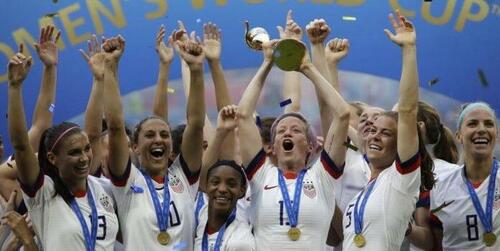
US Soccer's Equal Pay Deal Forces Men's World Cup Winnings to Split with Women's Team Amid 2026 Run
Credible reporting confirms the USMNT must share half its $12.8M net 2026 World Cup prize money with the USWNT under the 2022 equal-pay CBA, sparking debate on fairness, incentives, and market value in soccer.
Following the U.S. men's national team's round-of-16 exit at the 2026 FIFA World Cup, a longstanding collective bargaining agreement is redirecting a significant portion of their FIFA prize money to the women's program. The USMNT earned approximately $16 million from FIFA for advancing past the group stage before a 4-1 loss to Belgium. Under the 2022 CBAs ratified by U.S. Soccer with both national teams, the federation retains 20% ($3.2 million), leaving $12.8 million to be split evenly between the men's and women's player pools—$6.4 million each. With 26-player rosters, this equates to roughly $246,153 per player, though women's payouts remain in escrow pending qualification for the 2027 Women's World Cup.[1][2]
This arrangement stems from the landmark 2022 settlement of the USWNT's equal-pay lawsuit against U.S. Soccer, which included parallel CBAs establishing pooled prize-money sharing for World Cup cycles. The policy applies symmetrically: women's earnings from 2027 will also be shared. U.S. Soccer is the only federation with such a structure. Critics, including commentators on platforms like X, argue it disincentivizes performance by decoupling revenue from market draw, noting men's matches historically attract larger audiences and that FIFA's men's tournament generates far higher revenue than the women's. Supporters highlight it as a pioneering step toward equity following years of advocacy. The men's team has not advanced beyond the round of 16 since 2002, while the women have won multiple titles, though commercial disparities persist.[3]
Broader context reveals this as part of ongoing debates in sports economics, where equal-pay agreements intersect with revenue generation, viewership data, and federation finances. Similar discussions have surfaced in other leagues, but the U.S. model remains unique in its explicit pooling of FIFA World Cup funds.
LIMINAL: This pooling mechanism may accelerate calls for performance-based or revenue-tied compensation models across federations, potentially influencing future CBA negotiations as viewership and sponsorship gaps persist.
Sources (4)
- [1]U.S. men, women get equal split of $16M World Cup prize(https://www.espn.com/soccer/story/_/id/49301582/us-men-women-get-equal-split-16m-world-cup-prize)
- [2]U.S. men's World Cup exit still means a $6 million payday for USWNT(https://www.nytimes.com/athletic/7428474/2026/07/07/usmnt-world-cup-exit-million-dollar-payday-for-uswnt/)
- [3]US Soccer will split its World Cup prize money between men and women(https://fortune.com/2026/07/09/world-cup-usa-us-soccer-men-women-prize-money-split-equal-pay-fifa/)
- [4]Team USA Forced To Share Half Of World Cup Prize Money With Women’s Team(https://www.dailywire.com/news/team-usa-forced-to-share-half-of-world-cup-prize-money-with-womens-team)