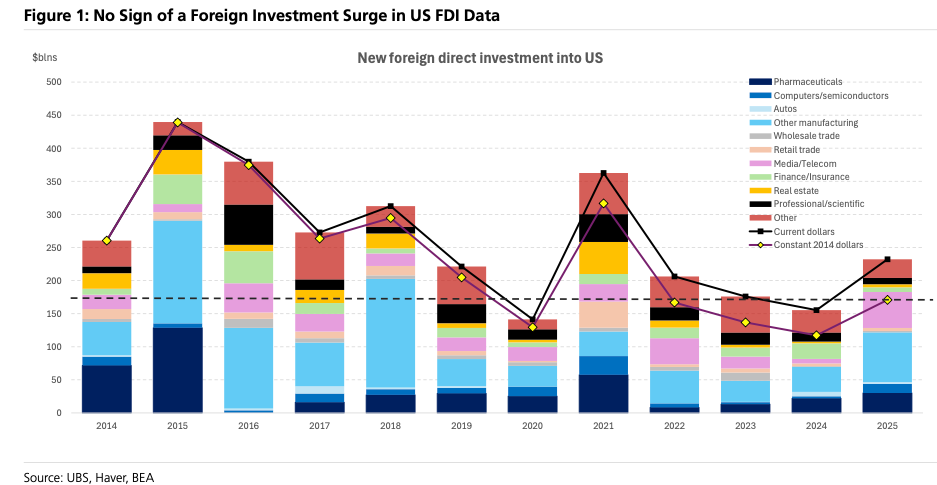
UBS Data Clash with White House: $232B Actual 2025 FDI vs. Trillions in Pledged Investments Highlights Acquisition-Heavy Flows
BEA-confirmed $232B 2025 FDI, mostly acquisitions, undercuts White House/Trump trillions-in-pledges narrative; highlights distinction between announcements and realized new capacity with implications for manufacturing revival and economic strategy.
Official U.S. Bureau of Economic Analysis (BEA) data released in June 2026 shows new foreign direct investment (FDI) expenditures totaled just $232.2 billion in 2025, a 49.5% increase from 2024 but still roughly $30 billion below the 10-year average and, in inflation-adjusted terms, below pre-pandemic levels. Acquisitions of existing U.S. firms accounted for $218.4 billion (94%), with only $4.6 billion for new establishments and $9.2 billion for expansions of existing foreign-owned operations. This aligns with UBS economist Arend Kapteyn's analysis questioning the scale of onshoring and manufacturing revival. President Trump's repeated claims of over $20 trillion in foreign investment during his second term—potentially reaching $25 trillion—stem from White House trackers listing multi-trillion-dollar pledges from the UAE ($1.4T), Qatar ($1.2T), Japan ($1T), Saudi Arabia, South Korea, and others exceeding $5T combined. However, fact-checks from CNN and others note these are largely announcements and frameworks, not realized flows, with the White House's own site citing around $11T in major commitments including domestic firms. Analyses from AEI and Steptoe underscore the gap: actual BEA flows remain modest, with Gulf pledges often encompassing economic exchange, purchase orders, or non-binding frameworks rather than immediate productive capacity. Broader context from fDi Intelligence and OECD reports shows global FDI rebounding unevenly in 2025, with U.S. manufacturing announcements (e.g., via IndustrialSage trackers exceeding $2T since 2025) driven by sectors like semiconductors and data centers, yet raising questions on job creation versus capital intensity and M&A dominance. Geopolitically, these tensions reflect voter concerns over trade imbalances and supply-chain resilience, where announced trillions may lag in translating to broad-based employment gains amid policy shifts.
[Economist/Arend Kapteyn]: Persistent gap between high-profile pledges and modest realized FDI—dominated by ownership changes rather than greenfield builds—suggests onshoring revival remains aspirational, potentially tempering job security gains and amplifying scrutiny on trade policy efficacy.
Sources (6)
- [1]New Foreign Direct Investment in the United States, 2025(https://www.bea.gov/news/2026/new-foreign-direct-investment-united-states-2025)
- [2]Fact check: Vance repeats Trump’s fictional ‘$19 trillion’ investment figure(https://www.cnn.com/2026/09/03/politics/fact-check-vance-trump-trillions-invested)
- [3]Trump says $20 trillion in foreign investment poured into U.S. since he took office(https://www.washingtontimes.com/news/2026/sep/9/trump-says-20-trillion-foreign-investment-poured-us-since-took-office/)
- [4]The Economic Risks Behind the United States $10 Trillion Investment Deals(https://www.steptoe.com/en/news-publications/stepwise-risk-outlook/the-economic-risks-behind-the-united-states-dollar10-trillion-investment-deals.html)
- [5]Numbers That Crunch President Trump(https://www.aei.org/foreign-and-defense-policy/numbers-that-crunch-president-trump/)
- [6]fDi Intelligence 2025 investment matrix(https://www.fdiintelligence.com/content/07d8bc90-96c9-4978-bea9-72e2f0185c11)