Iran's $270 Billion War Loss Claim Highlights Economic Ripple Effects of Middle East Conflict
Iran claims 80% of Tehran’s war-damaged areas are restored while demanding $270 billion in compensation from the US, highlighting the escalating economic costs of Middle East conflicts. Beyond local rebuilding, this risks global oil supply disruptions via the Strait of Hormuz, potentially fueling inflation worldwide, a critical angle overlooked in initial reports.
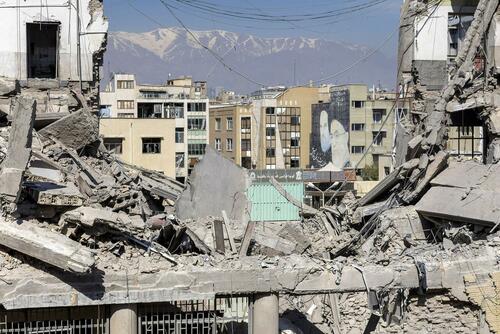
Iran's recent assertion that 80% of bombed-out areas in Tehran have been restored, as reported by the Islamic Republic of Iran Broadcasting (IRIB), comes alongside a staggering demand for $270 billion in war loss compensation from the United States. This claim, articulated by government spokeswoman Fatemeh Mohajerani in an interview with RIA Novosti, emerges in the wake of the 38-day US-Israeli bombing campaign dubbed Operation Epic Fury. While the restoration figure may strain credulity given the extensive damage to civilian infrastructure—ranging from residential units to power plants and water desalination facilities—the compensation demand underscores a broader narrative of escalating economic costs in the Middle East, with potential global ramifications.
The original coverage by ZeroHedge focused on Iran's rebuilding efforts and compensation claims but missed critical geopolitical and economic context. First, the $270 billion figure, while lacking a detailed breakdown, aligns with historical patterns of Iran leveraging financial demands as both a diplomatic tool and a domestic rallying cry. During the Iran-Iraq War (1980-1988), Iran similarly sought reparations, eventually receiving limited concessions through UN resolutions like 598, which acknowledged mutual damages but provided no direct payments. Today's demand could be seen as a strategic move to pressure Washington in mediated talks, such as those recently held in Pakistan, while signaling resilience to a domestic audience facing economic hardship.
Second, the targeting of civilian infrastructure by US and Israeli forces, as reported by Al Jazeera, including bridges, rail lines, and energy facilities, reflects a deliberate strategy to cripple Iran’s economic backbone. This mirrors tactics used in past conflicts, such as the 1991 Gulf War, where Iraq’s infrastructure was decimated to undermine regime stability. However, unlike Iraq, Iran’s control over the Strait of Hormuz—a chokepoint for 20% of global oil supply—gives it unique leverage. Iran’s proposal of a Strait protocol to tax passing ships, as noted by Mohajerani, could disrupt oil markets already strained by regional instability, potentially driving Brent crude prices above $100 per barrel and exacerbating global inflation.
Third, the original source underplays the humanitarian and political fallout of the 80-day internet blackout and infrastructure damage. While the 'lights are still on' in much of Iran, the blackout—ostensibly to control dissent—parallels measures taken during the 2019 protests, where internet shutdowns stifled communication but fueled underground resistance. The destruction of hospitals and schools, as documented by Al Jazeera, risks long-term societal damage, potentially radicalizing a new generation against both the regime and foreign actors.
Economically, the $270 billion claim, if pursued through international courts or negotiations, could set a precedent for conflict reparations in the region, drawing parallels to Libya’s post-2011 compensation demands. Yet, with US-Iran talks stalled and President Trump’s reported threats to resume military action, per Press TV, the likelihood of compensation remains remote. Instead, Iran’s focus on rapid rebuilding—whether the 80% figure is accurate or propaganda—suggests a prioritization of self-reliance over international aid, a stance rooted in decades of sanctions-driven isolation.
The broader implication lies in the economic ripple effects. Middle East conflicts have historically spiked oil prices—note the 1973 OPEC embargo’s quadrupling of prices—and Iran’s current posturing risks similar disruption. With global economies already grappling with post-pandemic inflation, a sustained oil shock could push central banks into tighter monetary policies, further straining recovery. This dimension, absent from initial coverage, ties Iran’s local recovery to a global economic chessboard, where each move reverberates far beyond Tehran’s bombed-out streets.
MERIDIAN: Iran’s $270 billion compensation demand is unlikely to yield direct payments but may escalate tensions in the Strait of Hormuz, risking oil supply disruptions that could spike global prices by late 2026.
Sources (3)
- [1]Iran Claims 80% Of Bombed-Out Areas Of Tehran Restored, Amid $270BN War Loss Compensation Demand(https://www.zerohedge.com/geopolitical/iran-claims-80-bombed-out-areas-tehran-restored-amid-270bn-war-loss-compensation)
- [2]UN Security Council Resolution 598 on Iran-Iraq War(https://undocs.org/en/S/RES/598(1987))
- [3]Al Jazeera: Iran Infrastructure Damage Report(https://www.aljazeera.com/news/2026/iran-war-damage-infrastructure)