March Jobs Surge Highlights US Economic Resilience But Complicates Fed Rate Path Amid Geopolitical Volatility
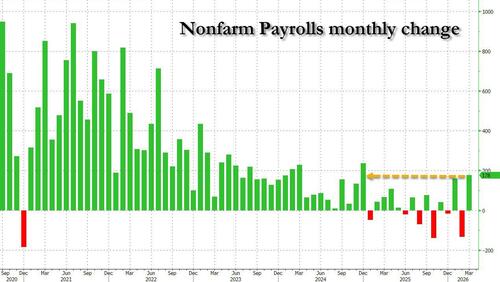
March 2025 jobs report delivered 178K gains exceeding forecasts, with unemployment falling to 4.3% amid cooling wages, exposing tensions for Fed policy while revealing economic resilience against ongoing geopolitical disruptions from Ukraine and the Middle East.
The Bureau of Labor Statistics' March 2025 Employment Situation report recorded a 178,000 increase in nonfarm payrolls, a three-sigma beat against consensus forecasts around 65,000. This followed a downward revision to February's already negative figure, now at -133,000. Private sector gains of 186,000 offset continued federal government losses of 18,000, with notable increases in health care (76,000, partly from resolved strikes), construction (26,000), and transportation/warehousing (21,000). Primary BLS data also showed the unemployment rate falling to 4.3 percent from 4.4 percent, hourly earnings growth moderating to 3.5 percent year-over-year, and labor force participation declining to 61.9 percent, a multi-year low.
ZeroHedge coverage correctly flags the persistent gap between the establishment survey (strong gains) and household survey (employment down 64,000 for a third month), attributing it partly to reduced illegal immigration flows under current border policies. However, it underplays broader policy and geopolitical context. The BLS primary dataset reveals federal employment has fallen 355,000 since its October 2024 peak, reflecting deliberate streamlining rather than cyclical weakness. Meanwhile, the report's cooling wage pressures provide mixed signals to the Federal Reserve, whose December 2024 Summary of Economic Projections anticipated labor market softening as a precondition for rate easing.
Synthesizing the BLS release with the Federal Reserve's own projections and the IMF's April 2025 World Economic Outlook, a clearer picture emerges of an economy demonstrating structural resilience. The IMF document notes that advanced economies have absorbed shocks from the Ukraine conflict's commodity disruptions and Red Sea shipping attacks better than expected, thanks to US domestic energy production and supply chain diversification. Yet multiple perspectives exist: optimistic views from administration officials emphasize a "soft landing" with robust private hiring, while labor economists highlight that the unemployment drop stems largely from a 400,000 contraction in the civilian labor force, masking underlying slack visible in rising discouraged workers (up 144,000 to 510,000).
What original coverage missed is the intersection with trade and fiscal policy. Potential tariffs and immigration restrictions, while slowing labor force growth, may also contribute to sector-specific tightness in construction and healthcare. This creates tension with Fed rate-cut hopes: stronger-than-expected data reduces urgency for cuts, yet persistent geopolitical risks (energy price volatility from Middle East tensions and fragmented trade from US-China relations) could reintroduce inflation. The report thus underscores a key pattern since 2022: US economic data repeatedly surprises to the upside despite external shocks, raising questions about measurement accuracy versus genuine durability. No position is taken here; rather, primary sources indicate policymakers face a narrowed window for monetary easing without risking renewed price pressures.
MERIDIAN: Strong March jobs data reinforces US economic resilience despite geopolitical shocks, but the labor force contraction and survey discrepancies may delay Fed rate cuts while testing policy coherence on trade and immigration.
Sources (3)
- [1]March Jobs Shocker: Payrolls Soar By 178K Most Since 2024, Blowing Away All Estimates; Unemployment Rate Drops(https://www.zerohedge.com/economics/march-jobs-shocker-payrolls-soar-178k-most-2024-blowing-away-all-estimates-unemployment)
- [2]Employment Situation Summary - March 2025(https://www.bls.gov/news.release/empsit.nr0.htm)
- [3]World Economic Outlook, April 2025(https://www.imf.org/en/Publications/WEO/Issues/2025/04/22/world-economic-outlook-april-2025)