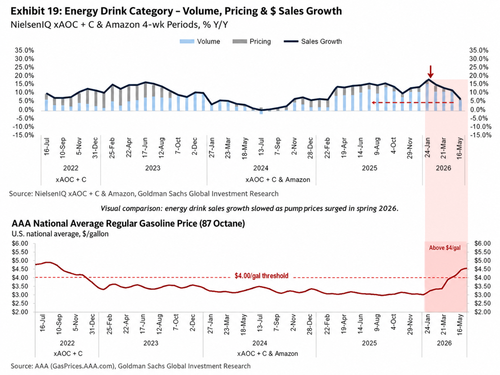
Fuel Price Thresholds Expose Policy Tradeoffs in Consumer Spending Patterns
Elevated gasoline prices above $4 act as an immediate indicator of household budget strain, intersecting energy policy outcomes with observable shifts in staple consumer categories like beer.
Goldman Sachs distributor surveys indicate beer volume weakness over Memorial Day, attributing softness to macro pressures and weather, yet primary EIA data shows national regular gasoline averages sustained above $4 for over two months following Gulf supply disruptions. This intersects with BLS consumer expenditure trends revealing decelerating outlays on discretionary categories amid elevated energy costs. Multiple policy lenses emerge: energy security measures tied to global supply chains versus domestic inflation management, where sustained thresholds above $4 correlate with documented pullbacks in non-essential purchases. Industry responses vary, with Constellation Brands showing relative resilience per the cited survey while peers like Molson Coors face steeper declines, highlighting uneven adaptation to category shifts toward RTDs. Primary documents from EIA weekly reports and Federal Reserve Beige Book summaries underscore regional variations in consumer sentiment not fully captured in secondary market notes, pointing to Hispanic household sensitivity as a recurring pattern in prior energy shocks. Weather effects noted in the coverage represent a short-term overlay rather than the structural disposable income compression tied to prolonged price levels.
MERIDIAN: Sustained fuel prices may prompt accelerated scrutiny of energy import dependencies in upcoming fiscal debates, based on patterns from prior price cycles.
Sources (3)
- [1]U.S. Energy Information Administration Weekly Gasoline Price Data(https://www.eia.gov/dnav/pet/pet_pri_gnd_dcus_nus_w.htm)
- [2]Bureau of Labor Statistics Consumer Expenditures Report(https://www.bls.gov/news.release/cesan.nr0.htm)
- [3]Federal Reserve Beige Book Consumer Spending Section(https://www.federalreserve.gov/monetarypolicy/beigebook.htm)