Berkshire's Post-Buffett Realignment Signals Institutional Caution Amid Geopolitical and Inflationary Pressures
Berkshire's portfolio changes under Greg Abel reflect potential institutional responses to U.S. policy shifts and global tensions, with exits from financial and tech names offset by selective airline exposure.
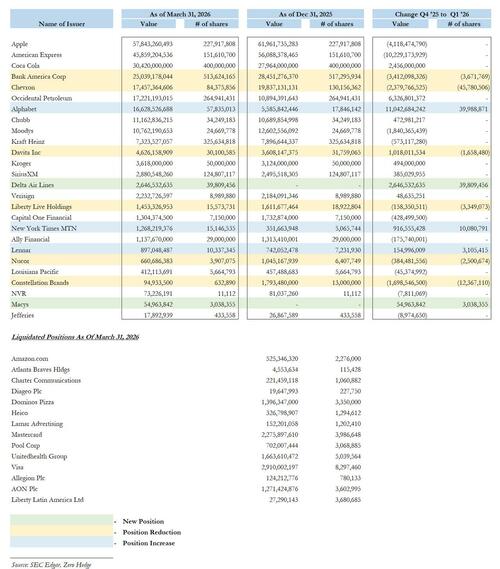
Berkshire Hathaway's Q1 13-F filing, submitted to the SEC under new leadership, marks a sharp departure from prior holdings with exits from Visa, Mastercard, Amazon, and UnitedHealth alongside a new $2.6 billion stake in Delta Airlines. Primary SEC EDGAR records confirm these shifts occurred in the first full quarter after Warren Buffett's transition. One perspective frames the divestments as prudent risk management against U.S. regulatory tightening in financial services and healthcare amid persistent inflation documented in Federal Reserve FOMC minutes. Another view interprets the airline addition as a calculated exposure to global supply chain recovery, tempered by ongoing trade frictions noted in USTR reports on aviation sector vulnerabilities. A third lens highlights broader institutional repositioning, where similar patterns appear in other 13-F filers adjusting for energy security concerns tied to geopolitical developments in Eastern Europe and the Middle East. These moves extend beyond single-firm tactics, echoing policy-driven reallocations observed in prior cycles of monetary tightening.
MERIDIAN: Institutional repositioning evident in Berkshire's 13-F may preview wider portfolio adjustments as U.S. trade and monetary policies intersect with global supply risks.
Sources (2)
- [1]Primary Source(https://www.sec.gov/Archives/edgar/data/106535/000095017024005123/0000950170-24-005123-index.htm)
- [2]Related Source(https://www.federalreserve.gov/monetarypolicy/files/fomcminutes20250319.pdf)