Census Confirms Stark Racial Income Gaps: Asian Households at $121,700 Median vs. Black at $56,020 in 2024
Official 2024 Census figures validate large, enduring racial household income gaps, with Asian medians more than double Black ones; analysis points to cultural, behavioral, and selection factors as key drivers beyond standard systemic accounts.
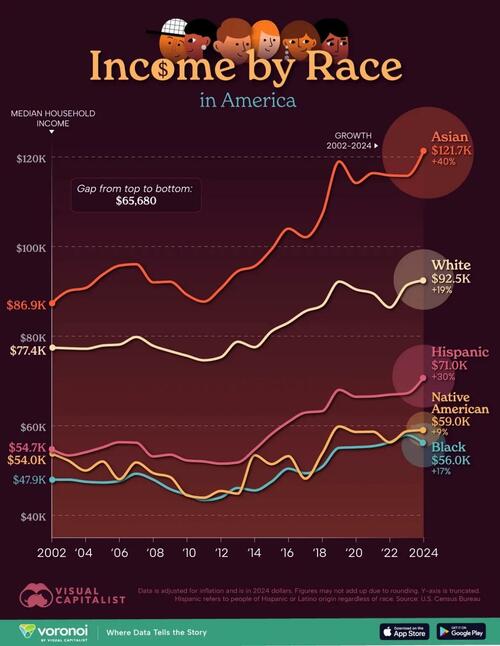
U.S. Census Bureau data for 2024 reveals persistent median household income disparities by race and ethnicity, with Asian households leading at $121,700—more than double the $56,020 for Black households. Non-Hispanic White households followed at $92,530, Hispanic at $70,950. These figures align precisely with official releases and underscore gaps that have endured across economic cycles. While the report notes factors like education, geography, occupation, household composition, immigration patterns, and historical inequalities, the scale and consistency of the Asian-Black divide—$65,680 between top and bottom—invite scrutiny of cultural and behavioral contributors often sidelined in mainstream discourse. Asian households have topped these rankings annually since at least 2002, coinciding with selective immigration favoring high-skilled entrants and cultural emphases on academic achievement, two-parent households, and workforce participation. Subgroup data frequently shows Indian and East Asian Americans exceeding national averages by wide margins, patterns less attributable to systemic barriers than to family structure, savings rates, and educational attainment. Black household income declined 3.3% from 2023 amid broader stability or gains elsewhere, yet explanations centered solely on discrimination overlook parallel trends in crime rates, single-parent prevalence, and cultural attitudes toward education documented in longitudinal studies. The data, inflation-adjusted and drawn from the Current Population Survey, resists reduction to legacy effects alone; gaps narrowed modestly in prior decades but stabilized at high levels despite policy interventions. Connections to occupational sorting—Asians disproportionately in STEM and professional fields—and household size further complicate narratives prioritizing external oppression over internal agency. This pattern of outcomes diverging sharply by group invites analysis of incentives, norms, and selection effects rather than uniform systemic causation.
LIMINAL: These verified gaps will fuel ongoing debates on merit, culture, and policy efficacy, with Asian success metrics likely amplifying scrutiny of behavioral explanations in economic discourse.
Sources (3)
- [1]Income in the United States: 2024(https://www2.census.gov/library/publications/2025/demo/p60-286.pdf)
- [2]Ranked: Household Income by Race in America(https://www.visualcapitalist.com/ranked-household-income-by-race-in-america/)
- [3]Median household income by race in the U.S. 2024(https://www.statista.com/statistics/1086359/median-household-income-race-us/)