Healthcare Specialists Dominate Top US Pay: The Clear Path to $400K+ Salaries Amid Deepening Shortages
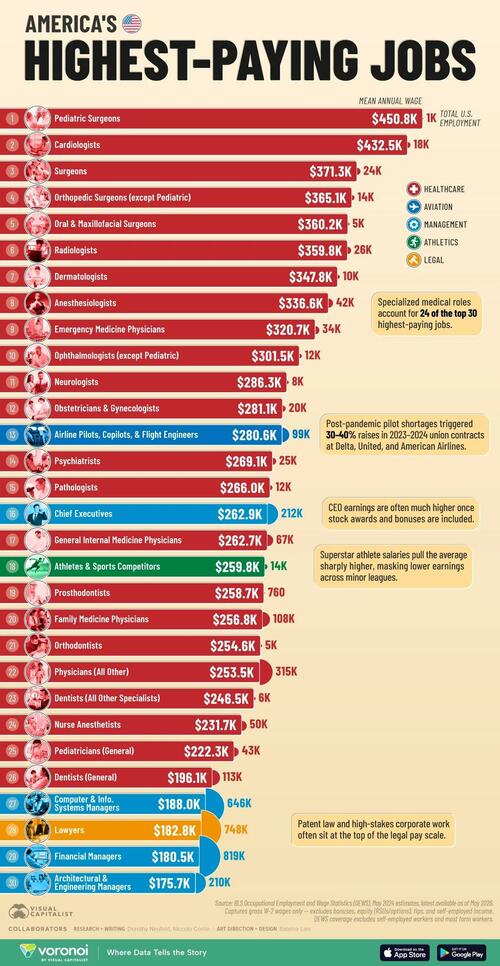
24 of top 30 highest-paid US jobs are healthcare specialists like pediatric surgeons ($500K+) with tiny employment pools; aging population and 10+ year training barriers drive shortages and pay, making specialized medicine the clearest high-earnings path resistant to AI.
According to the latest Bureau of Labor Statistics data, specialized healthcare roles continue to monopolize America's highest-paying occupations, with 24 of the top 30 positions held by physicians and surgeons. Pediatric surgeons lead the list with mean annual wages exceeding $500,000, followed closely by cardiologists at approximately $455,000, radiologists, orthopedic surgeons, and other procedural specialists. These elite roles command such compensation due to a potent combination of extreme supply constraints and unrelenting demand. Most require over a decade of intensive education, residency, and fellowship training, creating high barriers that few can surmount. Nationwide, there are only about 1,200 pediatric surgeons practicing, illustrating how rarity sustains premium pay even as America's aging population drives exponential need for complex interventions in cardiology, oncology, and surgery. The BLS and related analyses project a physician shortage surpassing 140,000 by the late 2030s, further entrenching these wage levels. This pattern reveals connections often overlooked in career discussions: high compensation in medicine isn't merely about 'helping people' but reflects a structural economic imbalance where demographic realities (boomer retirements, chronic disease prevalence) collide with regulatory, educational, and liability barriers that shield these professions from easy substitution. While AI and automation reshape many sectors, real-time surgical decision-making, physical procedures, and medicolegal accountability keep these roles uniquely human and highly compensated. Outside healthcare, only select positions break the ceiling—airline pilots and copilots average around $280,000 amid their own pilot shortages, while chief executives reach $263,000 through leadership oversight. Yet these pale compared to the medical tier and employ far larger cohorts. For career and salary decisions, the one-sentence takeaway is unambiguous: if maximizing earnings is the priority, pursue hyper-specialized medical training despite the debt, delayed gratification, and burnout risks, as no other field offers comparable upside or insulation from technological disruption in the coming decade. Healthcare spending is forecast to outpace overall economic growth through 2033, sustaining this dynamic even as systemic pressures like hospital consolidation and administrative burdens mount. Data from May 2025 confirms the pattern remains unchanged from prior years, underscoring its durability. Individuals evaluating ROI on education should note that while median US wages hover near $70,000, these top medical paths deliver 6-7x returns for those who complete the pipeline, concentrating high earnings in a small, elite workforce.
LIMINAL: Target specialized physician roles for top US pay as shortages and demographics lock in $400K+ earnings, but recognize decade-long training creates a high-stakes filter few overcome.
Sources (4)
- [1]Occupational Employment and Wages Summary(https://www.bls.gov/news.release/ocwage.nr0.htm)
- [2]Ranked: The 30 Highest-Paying Jobs in America(https://www.visualcapitalist.com/ranked-the-30-highest-paying-jobs-in-america/)
- [3]25 Highest-Paying Jobs in the U.S.(https://www.investopedia.com/personal-finance/top-highest-paying-jobs/)
- [4]The highest-paying jobs in the US, according to federal data(https://thehill.com/business/5890914-highest-paying-jobs-usa-labor-department-statistics/)