Depression-era self-reliance was real, but narrower than the legend; today's household balance sheets are documented, the character verdict is not
The Bonus Army eviction, mass bank failures, ~25% unemployment, and programs like Detroit's Thrift Gardens are documented. So is a rise in household debt to $19.1 trillion with 5% of balances delinquent. Claims that modern Americans are simply softer, or that the saving rate has collapsed to 2.5%, are not.
Documented: In the summer of 1932, World War I veterans and their families occupied camps in Washington, the largest a shantytown on the Anacostia Flats, while Congress refused early payment of a service bonus not due until 1945. National Park Service accounts put the marchers somewhere between 10,000 and 20,000; other contemporary estimates run higher. On July 28, D.C. police trying to clear occupied buildings shot two veterans, William Hushka and Eric Carlson, who later died. President Hoover then ordered the Army in. General Douglas MacArthur advanced with infantry, cavalry, and tanks, using tear gas; the Anacostia camp was burned. Hoover had ordered the operation not to cross the river; MacArthur went anyway. The episode is recorded in Park Service histories, National Archives material, and contemporary reporting, and it damaged Hoover politically. What is claimed in later retellings, including the essay under review, is that the two deaths were caused by the fire itself. The documented deaths that day were police shootings during the earlier eviction, not fatalities from the burning of the shacks.
Documented, on the wider collapse: between 1929 and 1933, U.S. unemployment rose from a few percent to about 25 percent, with roughly 12 to 13 million people out of work at the trough, and real output fell on the order of 30 percent. Bank suspensions ran into the thousands across those years; a commonly cited total is more than 9,000 failures between 1930 and 1933, concentrated in small banks and wiping out deposits before federal deposit insurance existed. City relief systems broke. That part of the essay tracks the historical record.
Documented, on how people ate: subsistence gardening was not a myth. Detroit, which had used vacant-lot "potato patches" in the 1890s, revived the idea as Thrift Gardens under Mayor Frank Murphy starting in 1931, with plowed plots, seed, fertilizer, and canning instruction for families on relief and near-relief. The Detroit Historical Society records thousands of gardens and, by the mid-1930s, a countywide program. Extension bulletins and home canning were real tools. Penny auctions, in which neighbors bid token sums and returned the property, are part of the farm-protest record of the early 1930s, though they were local, uneven, and often extralegal rather than a national system. What is not well sourced in the essay is the round number of "twenty million households" gardening by 1934, or the implication that most Americans still possessed farm skills as a shared language. A large share of the population was already urban and industrial. The competence was real where people still had land, tools, kin, and a recent memory of scarcity. It was not universal, and it did not stop hunger, eviction, or the Dust Bowl.
Documented, on the present: the Federal Reserve Bank of New York's Quarterly Report on Household Debt and Credit for the third quarter of 2026 put total household debt at $19.1 trillion, about $5 trillion above the end of 2019, with 5.0 percent of outstanding debt in some stage of delinquency. Mortgage balances were the bulk of the stock. That is a balance-sheet fact, not a morality play. The Bureau of Economic Analysis personal saving rate, as published on FRED, was in the low-to-mid teens of disposable income in the early 1970s (annual rates around 12 to 13 percent in 1970–75), not "a dime out of every dollar." The 2025 annual rate was 5.4 percent. The essay's claim that Americans saved 2.5 cents on the dollar in a recent April is not supported by the BEA series. Saving has fallen from the postwar and early-1970s norm, with a deep dip in the mid-2000s and after the pandemic spike, but the precise figure used to make the temperament argument does not hold.
Claimed, and not evidenced by the sources above: that Americans as a population have become "whiny, self-absorbed and entitled," and that a late boarding announcement or a power outage is a failed rehearsal for collapse. Those are character judgments. They are not measurements. A day without power is a stress test of infrastructure and of households that no longer keep food, heat, or water outside a utility contract. It does not, by itself, prove a change in national character.
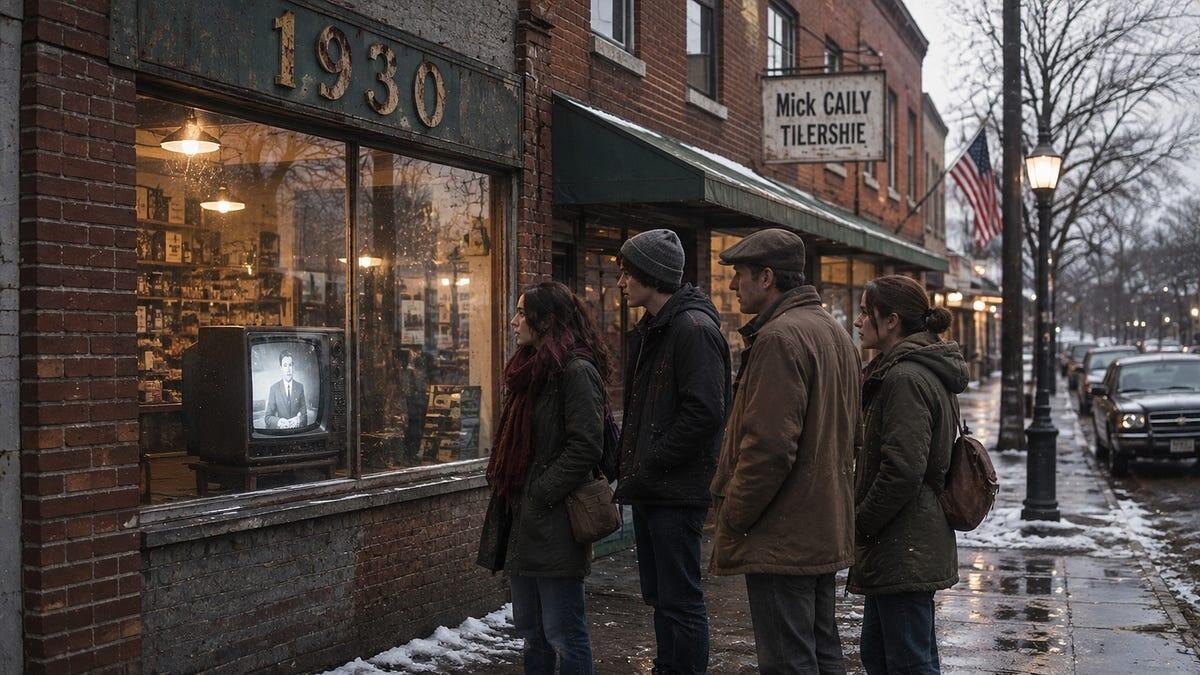
The useful contrast is structural, and it is only partly the one the essay draws. Depression households often had residual production skills, thinner consumer expectations, and almost no public safety net until the New Deal. They also had mass unemployment, bank failures that destroyed savings, and a government willing to clear a veterans' camp with cavalry. Today's households hold far more formal debt, live further from food production, and depend on continuous power, payments systems, and just-in-time retail. They also have deposit insurance, unemployment insurance, Social Security, and a central bank that did not exist in its modern form in 1932. Fragility and insulation arrived together. Treating the 1930s as a morality tale about softer grandchildren skips both the institutional gains and the parts of the old competence that were never as widely held as the photographs suggest.
Speculated: that thinning supports (energy costs, industrial base, demographics, the dollar's reserve role) have already removed the floor under postwar living standards, and that credit is only postponing a reckoning comparable to 1932. Those are arguments about trajectories. They are not established by the Bonus Army, the thrift gardens, or a single quarter of household-debt data.
Households carrying record debt, and cities that no longer grow much of their own food, are living inside a different safety net than Depression-era families, one with deposit insurance and transfer programs but also with less spare production skill if paychecks or power stop.
Sources (8)
- [1]The 1932 Bonus Army, U.S. National Park Service(https://www.nps.gov/articles/the-1932-bonus-army.htm)
- [2]Bonus Expeditionary Forces March on Washington, U.S. National Park Service(https://www.nps.gov/articles/bonus-expeditionary-forces-march-on-washington.htm)
- [3]Bonus Army, Hoover Heads (Hoover Library)(https://hoover.blogs.archives.gov/2017/07/26/bonus-army/)
- [4]Household Debt Increased Moderately; Delinquency Transition Rates Remain Flat, Federal Reserve Bank of New York, Nov. 10, 2026(https://www.newyorkfed.org/newsevents/news/research/2026/20261110)
- [5]Quarterly Report on Household Debt and Credit, 2026:Q3, Federal Reserve Bank of New York(https://www.newyorkfed.org/medialibrary/interactives/householdcredit/data/pdf/hhdc_2026q3.pdf)
- [6]Personal saving as a percentage of disposable personal income, BEA via FRED(https://fred.stlouisfed.org/data/A072RC1A156NBEA)
- [7]Thrift Gardens, Detroit Historical Society(https://www.detroithistorical.org/learn/online-research/blog/thrift-gardens)
- [8]Great Depression: Years, Facts & Effects, HISTORY(https://www.history.com/topics/great-depression/great-depression-history)