Why Your Grocery Bill Is Set to Explode: War, Fertilizer Shortages, and Super El Niño Converge on Food Prices
Geopolitical disruption from the Iran conflict closing the Strait of Hormuz has driven sharp rises in diesel and fertilizer prices, which—combined with U.S. drought and an emerging Super El Niño—are set to push U.S. food inflation significantly higher in the months ahead, directly increasing grocery costs for families.
While headlines fixate on $4.50+ gasoline, a more painful reality is quietly building for American households. The ongoing conflict with Iran has effectively disrupted shipping through the Strait of Hormuz, a chokepoint for roughly one-third of global fertilizer trade and critical energy supplies. Diesel prices have surged over 50% in places, directly raising costs for tractors, fishing boats, and the trucks that move 83% of U.S. agricultural goods. Fertilizer prices—already volatile—have jumped 10-30% or more since early 2026, with some inputs like urea nearly doubling. These costs do not stay on the farm; they flow straight into the price of bread, meat, produce, and packaged goods that hit family budgets every week.
Official data confirms food inflation is already accelerating. The U.S. Bureau of Labor Statistics reported food prices up 3.2% year-over-year in April 2026, with grocery-at-home prices rising 2.9% and sharp monthly jumps in fresh fruits and vegetables (over 6% in some categories). USDA forecasts for 2026 project all-food prices rising around 3.4%, but analysts warn this understates the pass-through still coming from spring planting costs. Farmers are absorbing higher diesel (now near $4.60/gallon in key states) and fertilizer during a critical season, meaning lower yields or sharply higher wholesale prices later this year.
The situation is compounded by domestic drought and a brewing "Super El Niño" expected to bring extreme weather patterns—intensifying dry conditions in key growing regions, disrupting monsoons in Asia, and threatening global harvests of wheat, rice, corn, and soybeans. JPMorgan and other analysts note this climate overlay on already tight fertilizer supply creates a multiplier effect: reduced output meets higher input costs, pushing food inflation higher for months or years.
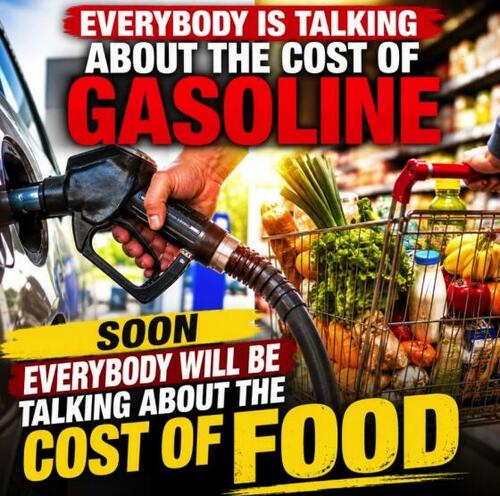
This is not abstract. Unlike distant supply chain stories, higher grocery bills are immediate, visible, and personal. Families already stretched by gas prices will face another 10-20% or more in effective food cost increases on staples if trends hold, according to warnings from economists and farm groups. The chain is clear: Hormuz disruption → energy and fertilizer spike → higher farming and transport costs + weather shocks → empty wallets at checkout. Media focus on gasoline has obscured this "next story"—food—but the anger it will generate when families see their weekly shop jump by $50 or $100 will be hard to ignore. Reopening the Strait offers relief, but with Iran signaling long-term control, the pain may become structural. Sources across business, agriculture, and international reporting confirm the mechanisms and the timeline: impacts are already baked into 2026 harvests and will reach consumers within months.
LIMINAL: Your grocery bill is about to punch you in the gut within months as diesel, fertilizer, and weather shocks from the Iran war and Super El Niño get passed straight onto meat, produce, and staples—triggering real anger when families feel it at the checkout every single week.
Sources (6)
- [1]Iran war: Strait of Hormuz shutdown could spark food crisis(https://www.dw.com/en/iran-us-israel-war-food-crisis-prices-fertilizer-energy-costs-inflation/a-76286348)
- [2]Iran news: Food prices could rise due to fertilizer shortages(https://www.cnbc.com/2026/03/11/iran-news-food-prices-could-rise-due-to-fertilizer-shortages.html)
- [3]Farmers warn of food price spike as war drives up fuel and fertilizer costs(https://www.pbs.org/video/impacts-of-war-1775509502/)
- [4]Global food crisis? Not just yet, but food inflation is coming as Strait of Hormuz remains closed(https://www.theglobeandmail.com/business/commentary/article-global-food-crisis-not-just-yet-but-food-inflation-is-coming-as-strait/)
- [5]Food Price Outlook - Summary Findings(http://www.ers.usda.gov/data-products/food-price-outlook/summary-findings)
- [6]Consumer Price Index Summary - 2026 M04 Results(https://www.bls.gov/news.release/cpi.nr0.htm)