From Civilian to Military Economy: Historical Patterns and Modern Implications of a Declining Empire
This article examines the U.S. shift toward a military-focused economy, as evidenced by an 80% surge in defense capital goods orders against declining civilian investment. Drawing on historical patterns of declining empires like Rome and the Soviet Union, it explores overlooked geopolitical drivers, global investor risks, and policy trade-offs, warning of sustainability challenges in a interconnected world.
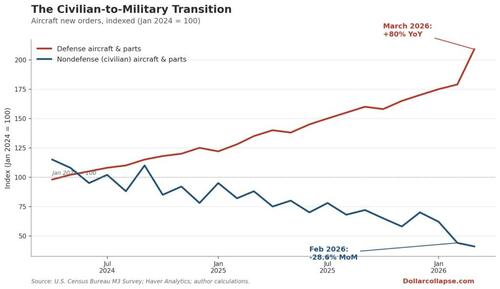
The recent data from the U.S. Census Bureau, as highlighted in a ZeroHedge article, reveals a stark shift in economic priorities: defense capital goods orders surged by 80% year-over-year in March 2026, while non-defense capital goods contracted for the sixth time in seven months. This divergence underscores a broader historical pattern observed in declining empires, where resources are increasingly diverted from civilian sectors to military needs, often at the expense of long-term economic sustainability. The original coverage frames this as a late-stage imperial transition, citing historical parallels like Rome under Diocletian and Britain post-1914. However, it misses critical nuances about the geopolitical drivers behind this shift and the potential feedback loops in global investor sentiment and policy responses.
Historically, empires facing internal decay or external threats have prioritized military expenditure to maintain control or project power. The Roman Empire’s militarization under Diocletian, as documented in primary sources like the 'Edict on Maximum Prices' (301 CE), diverted resources from infrastructure to legions, contributing to economic stagnation. Similarly, Britain’s post-World War I economy saw a reallocation toward naval dominance, with the 1920s budget data from the UK National Archives showing defense spending outpacing civilian investment even during peacetime. The U.S., post-1971 after the Nixon Shock decoupled the dollar from gold, mirrors this trend. The ZeroHedge piece correctly identifies the Vietnam War era as a pivot point, with federal deficits ballooning despite the war’s wind-down (U.S. Treasury data shows a shift from a $3 billion surplus in 1969 to a $23 billion deficit by 1972). Yet, it overlooks how current geopolitical tensions—such as U.S.-China rivalry and Middle East instability—amplify this militarization beyond mere economic decay.
What the original coverage also misses is the global context. The Pentagon’s projected $2.5 trillion national security request for 2027, as reported by the Department of Defense’s budget overview, does not yet account for potential escalations like a conflict with Iran. This raises questions about sustainability when juxtaposed with civilian sector contraction. The Federal Reserve’s recent monetary expansion, with M2 money supply hitting multi-year highs (Federal Reserve Economic Data, FRED), echoes Ludwig von Mises’ 1912 warning about inflationary pressures when taxation or borrowing become politically untenable. But the analysis stops short of exploring how this could erode international confidence in U.S. Treasuries, already under pressure as foreign holders net-sell (U.S. Treasury International Capital data). A declining empire’s economy risks a vicious cycle: military spending necessitates money printing, which devalues the currency, further deterring foreign investment and pushing reliance on domestic inflation.
From another perspective, some policymakers argue that defense spending acts as an economic stimulus, creating jobs and driving innovation. Historical data from the U.S. Bureau of Labor Statistics shows defense-related manufacturing supported millions of jobs during Cold War peaks. However, this view ignores the opportunity cost—funds diverted from education, healthcare, or infrastructure, as seen in the current non-defense CapEx decline, weaken long-term productivity. Investors, too, face a dilemma: while defense contractors like Lockheed Martin report record backlogs (SEC filings, Q3 2026), broader market sentiment may sour if civilian economic health deteriorates, potentially triggering capital flight to safer assets like gold, as the original piece suggests.
The deeper connection lies in how this military-civilian imbalance signals a structural shift with historical echoes. The Soviet Union’s collapse in 1991, driven partly by unsustainable military spending (estimated at 15-20% of GDP by CIA declassified reports), offers a cautionary tale. The U.S. is not at that threshold—defense spending is roughly 3.5% of GDP (World Bank data)—but the trajectory, combined with debt servicing costs exceeding $1 trillion annually (U.S. Treasury), hints at a slow bleed. Unlike Rome or the Soviets, the U.S. operates in a globalized economy where policy missteps can trigger rapid financial contagion. The original article’s focus on domestic data misses this interconnected risk, underestimating how a militarized economy could alienate allies reliant on U.S. economic stability, potentially reshaping trade and security alliances.
In sum, the shift from civilian to military economy is not just a symptom of decline but a policy choice with cascading effects. It reflects historical patterns of imperial overreach, yet operates in a modern context where global financial systems amplify the stakes. Whether this trajectory can be reversed depends on whether policymakers prioritize short-term security over long-term economic health—a question the data raises but does not answer.
MERIDIAN: The continued prioritization of military spending over civilian investment may accelerate U.S. economic vulnerabilities, potentially triggering a loss of confidence in Treasuries among foreign investors within the next 18-24 months if geopolitical tensions escalate further.
Sources (3)
- [1]U.S. Census Bureau: Manufacturers’ Shipments, Inventories, and Orders(https://www.census.gov/manufacturing/m3/index.html)
- [2]Department of Defense Budget Overview FY 2027(https://www.defense.gov/News/Releases/Release/Article/3678902/fy-2027-defense-budget-request/)
- [3]Federal Reserve Economic Data (FRED): M2 Money Supply(https://fred.stlouisfed.org/series/M2SL)