JPMorgan flags 5% food inflation by H1 2027 from Hormuz disruption and El Niño overlap
JPMorgan links Strait of Hormuz energy shocks and an emerging El Niño to sustained fertilizer and food price pressure through mid-2027. The note highlights asymmetric stockpiling by China and concentrated exposure in South and Southeast Asia. Primary records show rising FAO indices and renewed export curbs consistent with the projected timeline.
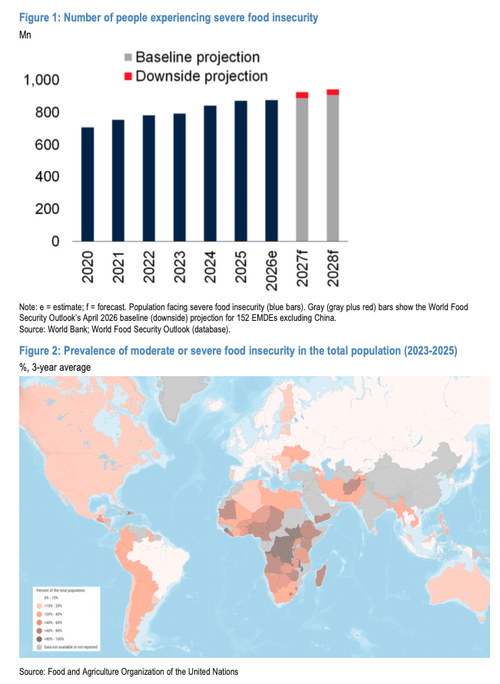
JPMorgan's August report models the interaction of energy chokepoint risk and weather as additive shocks to fertilizer costs. It projects the current Hormuz constraint will roughly double the historical 0.7 percentage point food CPI lift from a super El Niño, producing a combined 1.5 point increase through mid-2027. The analysis centers on lagged agricultural responses six to twelve months after oceanic peaks and on EM economies where food weights exceed 30% of consumption baskets.
China's documented accumulation of fertilizer, grains, and energy stocks since 2022 functions as a buffer that reduces its exposure relative to import-dependent states. India, Indonesia, and Brazil face concentrated price transmission because weather-sensitive crops dominate output and policy tools for export restraint remain available. Western strategic reserves cover oil but hold no equivalent fertilizer position, shifting the incidence of any prolonged Hormuz closure onto commercial channels.
FAO data already record the global food price index at a three-year high in July, consistent with the early phase of the modeled sequence. Export controls on rice and fertilizers have reappeared in multiple Asian and African suppliers, reproducing the 2022 pattern of quantity restrictions that amplify price volatility.
Absent de-escalation at Hormuz or rapid replenishment of soil nutrient stocks, the 2026-2027 window will test whether EM central banks can contain second-round wage effects before they feed into broader inflation targets.
JPMorgan: Global food inflation will reach or exceed the 5% annualized rate in H1 2027 if Hormuz throughput remains below 2024 averages through Q4 2026.
Sources (2)
- [1]Primary Source(https://www.fao.org/worldfoodsituation/foodpricesindex)
- [2]Supporting Source(https://www.imf.org/en/Publications/WEO)