JOLTS Divergence Exposes Labor Market Fractures, Forcing Reassessment of Rate-Path Assumptions
Anomalous JOLTS signals—surging openings against plunging quits—challenge soft-landing assumptions and inform divergent Fed policy expectations.
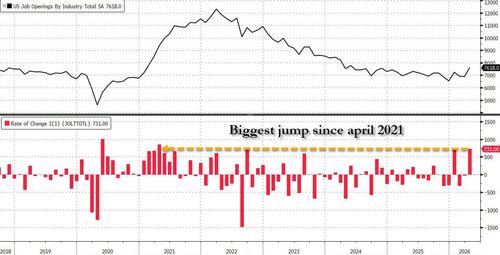
The April JOLTS release from the Bureau of Labor Statistics revealed job openings jumping 731,000 to 7.618 million—a 9-sigma beat—while quits fell to their lowest level since 2020. Primary BLS data shows the increase concentrated in professional and business services alongside a 47,000 gain in government openings, reversing nine months of labor surplus relative to unemployed workers. This pattern contrasts with contemporaneous ADP employment figures and Fed Beige Book anecdotes of cooling demand, suggesting either classification shifts or unreported rehiring dynamics not captured in payrolls. One perspective, drawn from Federal Open Market Committee minutes, interprets elevated openings as evidence supporting a higher-for-longer stance to anchor inflation expectations. An alternative reading, aligned with historical revisions in BLS series post-2022, flags potential seasonal-adjustment distortions amplified by post-pandemic labor reallocation. The quits collapse, absent from most mainstream coverage, implies reduced worker bargaining power and may foreshadow slower wage diffusion into services inflation. Neither view resolves whether the data reflect genuine stabilization or measurement artifacts ahead of the next payrolls print.
MERIDIAN: Mixed JOLTS signals increase odds of delayed rate cuts as policymakers weigh data reliability against cooling narratives.
Sources (3)
- [1]BLS Job Openings and Labor Turnover Survey April 2026(https://www.bls.gov/news.release/jolts.nr0.htm)
- [2]Federal Reserve FOMC Minutes April 2026(https://www.federalreserve.gov/monetarypolicy/fomcminutes20260429.htm)
- [3]Federal Reserve Beige Book April 2026(https://www.federalreserve.gov/monetarypolicy/beigebook202604.htm)