Korea's AI 'National Dividend' Trial Balloon: A Potential Global Precedent for Taxing Tech Windfalls
South Korean official Kim Yong-beom's suggestion to redistribute AI boom tax revenues as citizen 'national dividends' caused sharp KOSPI declines before clarification as personal opinion. The idea highlights global tensions over AI-driven inequality and may preview wider fiscal interventions in tech profits.
In a move that sent shockwaves through global markets on May 12, 2026, South Korean presidential policy chief Kim Yong-beom proposed channeling excess tax revenue from the artificial intelligence boom into a 'national dividend' for citizens. Posted on Facebook, Kim's remarks emphasized that gains from AI infrastructure—particularly in memory chips and high-bandwidth memory where Korean firms like Samsung Electronics and SK Hynix dominate—are not solely the product of individual companies but stem from decades of national industrial investment. He argued for structural redistribution to address inequality, drawing parallels to Norway's management of oil profits in the 1990s.[1][2]
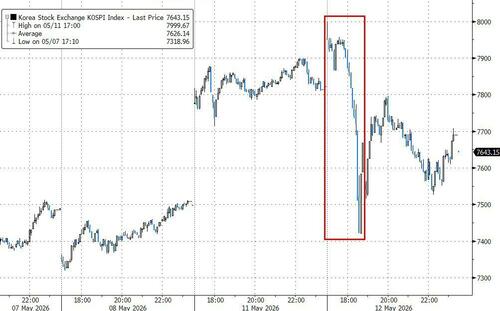
The proposal, though clarified as Kim's personal opinion and focused on surplus tax revenue rather than a direct windfall tax on corporate profits, triggered immediate market chaos. South Korea's benchmark KOSPI index plunged as much as 5.1%, erasing over $300 billion in market value temporarily, with ripple effects felt in European bourses and Nasdaq futures. Investors interpreted the comments as a potential threat to the extraordinary profits enjoyed by semiconductor giants fueling the global AI supply chain. Damage control from the presidential office followed swiftly, stressing no formal policy discussions were underway.[1][3]
This episode illuminates deeper tensions between rapid technological innovation and fiscal policy. As AI concentrates enormous value in a handful of firms and skilled workers, policymakers worldwide face growing calls to mitigate the resulting economic divides. Korea's strategic position in AI hardware—supplying critical components for leaders like Nvidia—amplifies the stakes; any precedent set here could influence debates in the US, EU, and beyond on 'robot taxes,' data dividends, or windfall levies on hyperscale tech profits. Unlike traditional corporate taxation, Kim's framework envisions using cyclical excess revenues from structural booms, potentially offering a more palatable model for sharing gains without directly punishing innovation.[4][5]
The timing is notable. Korean chipmakers have posted record profits amid exploding demand for AI infrastructure, yet public sentiment—exacerbated by labor disputes at Samsung—demands broader sharing of spoils. This mirrors international patterns: from proposals for universal basic income funded by automation windfalls to regulatory scrutiny of Big Tech's market power. If formalized, Korea's approach could resonate globally, as noted by financial observers, pressuring concentrated AI winners and reshaping investment theses around leveraged semiconductor plays. However, the swift market reaction and official walk-back highlight the fragility of sentiment around the AI trade, where retail enthusiasm and derivative products amplify volatility. Ultimately, this incident underscores a critical policy crossroads: harness AI-driven prosperity for social cohesion, or risk backlash that could stifle the very innovation driving economic transformation.
LIMINAL: Korea's AI dividend proposal could spark parallel debates in the US and Europe on redistributing concentrated tech gains, potentially cooling investor frenzy in AI infrastructure while establishing fiscal tools that balance innovation incentives against societal pressures.
Sources (4)
- [1]Korea Roils Market by Floating 'Citizen Dividend' From AI(https://www.bloomberg.com/news/articles/2026-05-12/korea-floats-citizen-dividend-using-ai-profits-samsung-falls)
- [2]Chief policy staff's idea of 'national dividends' using AI profit triggers concerns(https://www.koreatimes.co.kr/amp/business/companies/20260513/chief-policy-staffs-idea-of-national-dividends-using-ai-profit-triggers-concerns)
- [3]Lee aide suggests sharing AI boom tax windfalls through 'national dividend'(https://www.koreaherald.com/article/10736418)
- [4]Presidential official proposes 'public dividends' from AI-driven economic boom(https://www.upi.com/Top_News/World-News/2026/05/12/korea-Korea-AI-boom-public-dividend-Kim-Yong-beom-presidential-policy-chief/6461778578279/)