The Silent Fracture: Expiration of New START and Deepening Russia-China Ties Mark the End of Predictable Great-Power Rivalry
The end of New START in February 2026, coupled with a structural Russia-China strategic axis and incidents like the Venezuelan tanker seizure, signals a dangerous transition to unconstrained multipolarity where traditional guardrails on nuclear competition and great-power behavior have dissolved, creating elevated systemic risks of miscalculation and escalation across theaters.
While headlines focus on isolated crises in Ukraine or the South China Sea, a deeper systemic shift has occurred largely unnoticed. On February 5, 2026, the New START treaty officially expired without renewal or successor, ending the last formal limits and verification mechanisms on U.S. and Russian deployed strategic nuclear weapons for the first time since the 1970s. As the UN Secretary-General warned, this marks "a grave moment for international peace and security." Council on Foreign Relations experts describe it as the close of an era that provided measurable ceilings and transparency, now replaced by open-ended planning assumptions in defense ministries that quietly fuel arms race dynamics.
Compounding this is the structural consolidation of the Russia-China partnership. No longer a tactical alignment of convenience, Moscow and Beijing share deep strategic convergence: mutual resistance to U.S. sanctions as tools of coercion, advocacy for diluting Western dominance in global institutions, and a coordinated push toward multipolarity. Recent analyses from The Diplomat and SWP Berlin characterize this as an enduring axis challenging the liberal international order, extending beyond Eurasia into economic coordination, joint military exercises, and parallel institutions like BRICS and the SCO. Russian political psychology, reshaped by years of NATO expansion, sanctions, and conflict in Ukraine, makes reversal under future leadership unlikely.
These developments connect in ways mainstream coverage often misses. The removal of nuclear "guardrails" reduces predictability exactly as proxy and hybrid pressures intensify in multiple theaters. In the Western Hemisphere, the U.S. Coast Guard's January 2026 seizure of a Russian-flagged oil tanker linked to Venezuela—after a weeks-long pursuit involving submarines and surveillance—illustrates Moscow's willingness to test boundaries in America's traditional sphere, per reporting from Reuters, NPR, and Politico. Such actions, combined with the opacity following New START's end, erode the Cold War-era logic that allowed rivals to gauge and bound threats.
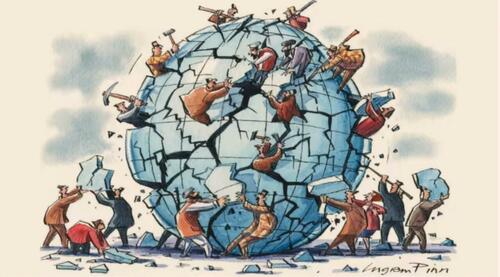
The old triangular diplomacy—manipulating relations between Washington, Moscow, and Beijing—has dissolved into a durable alignment of convenience between the latter two. This emergent multipolarity carries systemic risks: heightened miscalculation potential without verification data, accelerated military modernization, erosion of post-WWII norms, and competing visions of regional dominance. Economic statecraft, sanctions evasion, and alternative financial architectures further reinforce the shift. What appears as disparate events is in fact the quiet dissolution of the limits that once kept rivalry from becoming dangerously unmoored. Without renewed frameworks incorporating China and addressing new technologies, the global order is not collapsing loudly but fracturing through the steady removal of its foundational predictability.
LIMINAL: Without nuclear limits or shared predictability, the entrenched Russia-China axis will drive competitive multipolarity marked by accelerated arms buildups and higher spillover risks from contested spheres, turning isolated crises into systemic volatility.
Sources (5)
- [1]Nukes Without Limits? A New Era After the End of New START(https://www.cfr.org/articles/nukes-without-limits-a-new-era-after-the-end-of-new-start)
- [2]Statement by the Secretary-General on the Expiration of New START(https://www.un.org/sg/en/content/sg/statements/2026-02-05/statement-the-secretary-general-the-occasion-of-the-expiration-of-the-treaty-measures-for-the-further-reduction-and-limitation-of-strategic-offensive-arms-(new-start))
- [3]A Coordinated Trans-Eurasian Threat: The Deepening China-Russia Strategic Partnership(https://thediplomat.com/2026/03/a-coordinated-trans-eurasian-threat-the-deepening-china-russia-strategic-partnership/)
- [4]US seizes Venezuela-linked, Russian-flagged oil tanker after weeks-long pursuit(https://www.reuters.com/business/energy/us-seizing-venezuela-linked-oil-tanker-after-weeks-long-pursuit-2026-01-07/)
- [5]Multipolarities – The World-Order Visions of Others(https://www.swp-berlin.org/publikation/multipolarities-the-world-order-visions-of-others)