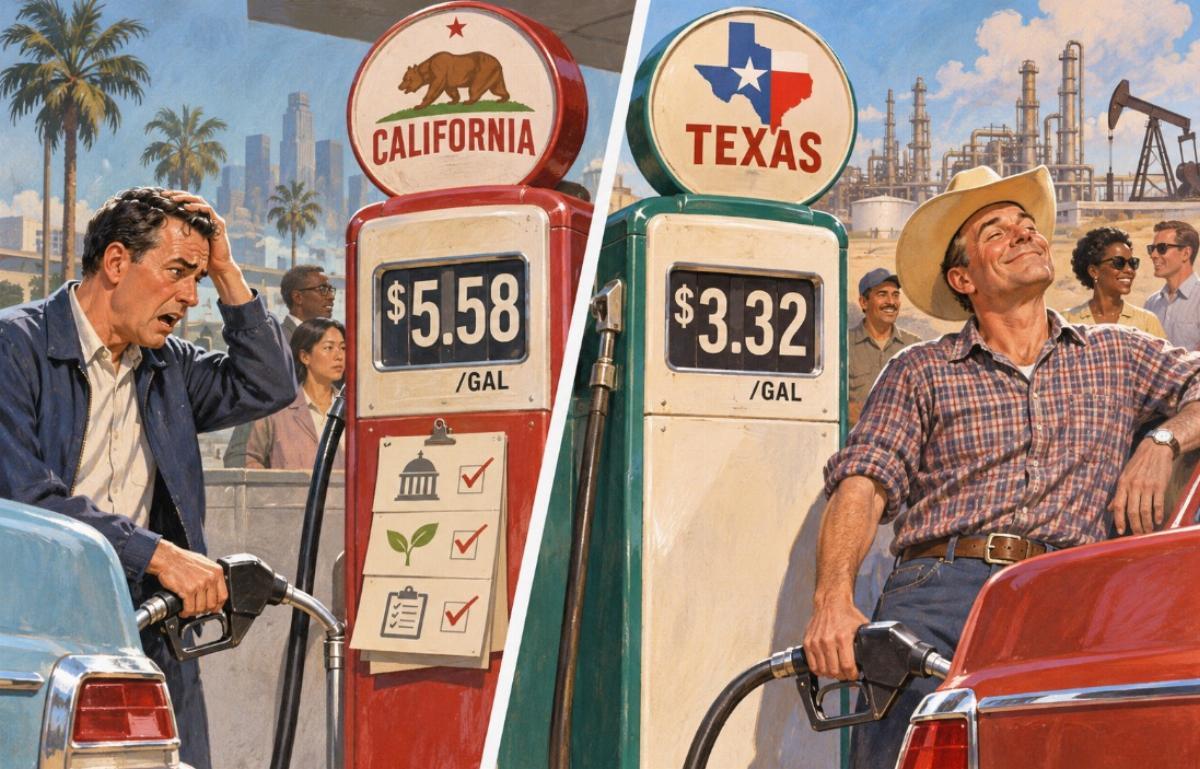
AAA-Based Comparison Shows Californians Pay 68% More at Pump Than Texans as Post-Election Drops Uneven
An AAA-based comparison says California pump prices are 68% above Texas and post-election declines were uneven by state. It matters because state tax, refining capacity and climate rules translate directly into household fuel costs. The pattern shows a budget divide shaped by policy and geography.
The article compares retail gasoline prices across U.S. states after the 2026 election and finds California pump prices 68% higher than Texas. It says the 11 days after the election brought lower prices nationwide, but the percentage declines were not uniform. States with predominantly Democratic-controlled legislatures from 2016 to 2025, including California, Oregon, Washington and Nevada, saw smaller reductions than many states with predominantly Republican-controlled legislatures, according to the piece.
The piece relies on AAA data and legislative control histories. It reports that 15 of the 25 highest-priced states were predominantly Democratic-controlled, and the five most expensive states were Hawaii, California, Nevada, Washington and Oregon. It also says 21 of the 25 lowest-priced states were predominantly Republican-controlled, and the 16 cheapest states all fell in that group. The article notes caveats: Hawaii's island shipping costs, inland supply routes, and North Carolina's tax holiday can distort state comparisons. The excerpt does not detail methodology.
The comparison points to structural differences between California and Texas. California's refinery count fell from 43 in the early 1980s to 12 at the start of 2026, with capacity around 1.5 million barrels per day, while crude output dropped 77% from 1985 to August 2026. State taxes, a 2-cent storage tank fee, federal tax, cap-and-trade and the Low Carbon Fuel Standard add costs. Texas keeps more of the refining and production base that California lost, and the article attributes the gap to that structure.
The ledger is two-sided. High-price states collect excise revenue and impose compliance costs, but households absorb those costs at the pump. Low-price states gain consumer purchasing power and may attract shipping, refining and logistics activity, while facing pressure on road funding, environmental standards and long-term fuel transition costs. The result is a household budget divide that tracks policy choices, geography and market structure rather than a single national price.
Households in high-tax, high-regulation fuel markets pay more for each gallon, while lower-cost states preserve purchasing power but face trade-offs in road funding and environmental policy.
Sources (1)
- [1]Original source(https://www.zerohedge.com/personal-finance/californians-pay-68-more-pump-texans-and-blue-states-got-smaller-post-election)