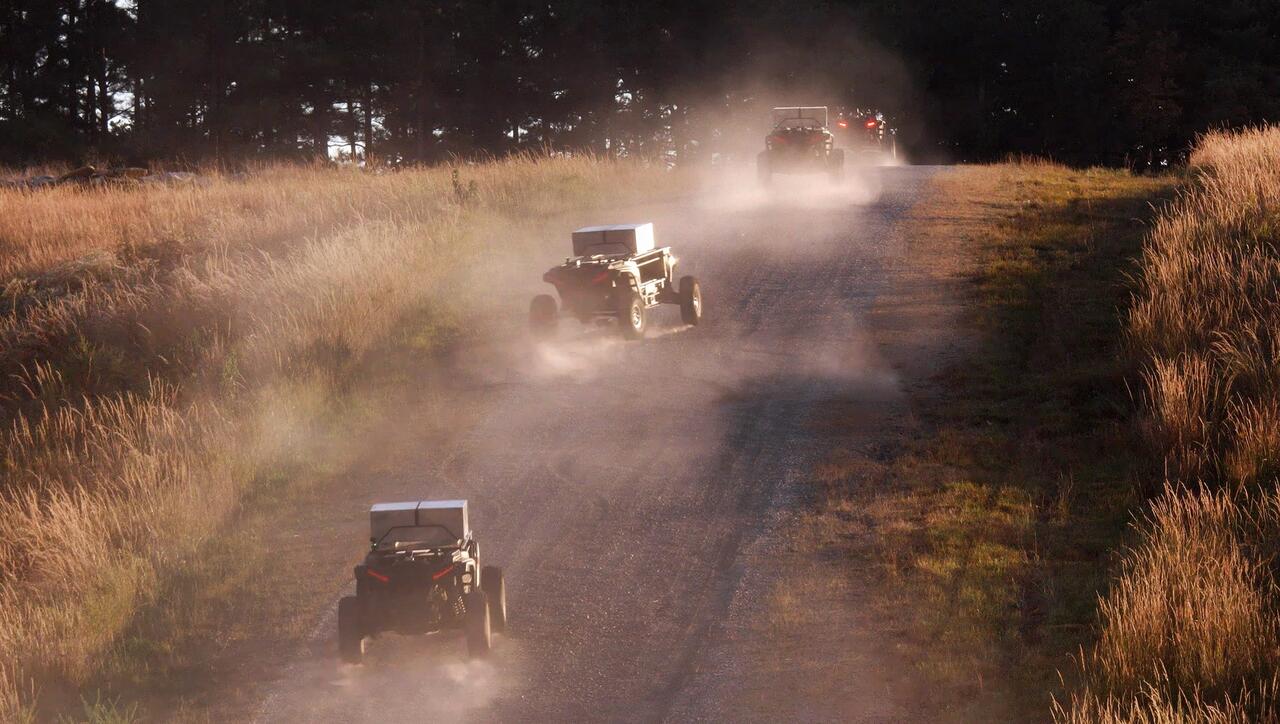
DARPA RACER Vehicles Complete Fort Knox Demonstration for EUCOM Autonomous Reconnaissance
DARPA's RACER demonstration at Fort Knox tested autonomous ground vehicles for pre-troop reconnaissance under EUCOM requirements, preserving human control over lethal decisions. The test aligns with US incentives to reduce soldier exposure while documenting technical limits and policy constraints. Primary records show incremental capability development rather than autonomous lethal authority.
The demonstration involved sequential vehicle movement: one RACER platform climbed terrain to scan for targets via satellite data, halted upon detection, and received support from two others before a human-authorized drone strike 300 yards away. DARPA deputy program manager Jason Gregory stated the exercise addressed EUCOM requests to test forward autonomous capabilities in European-like terrain without exposing troops. The system maintained compliance with Department of Defense policy requiring human approval for lethal force decisions.
Fort Knox terrain was chosen to replicate operational conditions for potential EUCOM deployment, reducing exposure in the last tactical mile where supply and reconnaissance missions carry high risk. The Army's parallel solicitations on unmanned logistics reflect the same incentive to shift dangerous tasks to machines. Primary records show the program prioritizes navigation autonomy over independent strike authority.
Competing interests include lowered US personnel risk against potential adversary acceleration of similar systems and alliance concerns over lowered escalation thresholds. DARPA records indicate the demonstration serves as a proof-of-concept for follow-on programs rather than immediate fielding. Costs include technical reliability gaps in contested electromagnetic environments and the requirement for persistent human-in-the-loop infrastructure.
Next steps involve integration of RACER-derived navigation into existing Army unmanned vehicle programs, with EUCOM likely to request expanded trials measuring detection rates against simulated peer adversaries by late 2025.
US Army: RACER navigation modules integrated into at least one EUCOM exercise with measurable target detection rates above 70 percent by December 2025
Sources (3)
- [1]DARPA RACER Program Page(https://www.darpa.mil/program/racer)
- [2]Task & Purpose Fort Knox Report(https://taskandpurpose.com/military/army-darpa-racer-demo/)
- [3]DoD Autonomous Weapon Policy Directive(https://www.defense.gov/News/News-Stories/Article/Article/3270307/)