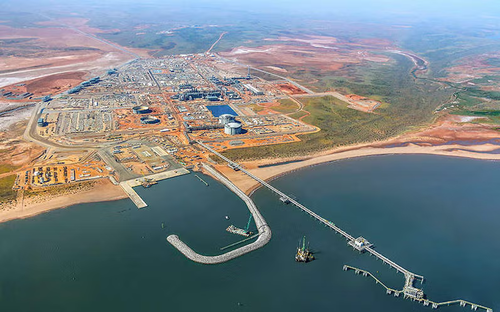
Global LNG Crisis Intensifies: Cyclone Damage at Chevron's Wheatstone Plant Compounds Qatar Outages from Iranian Strikes
Storm damage from Cyclone Narelle delays Chevron Wheatstone LNG restart by weeks, compounding over 25% global supply disruption from Iranian attacks on Qatar's Ras Laffan, revealing interconnected climate and geopolitical risks to energy security.
The global liquefied natural gas (LNG) market faces escalating pressure as storm damage from Tropical Cyclone Narelle has delayed the restart of Chevron's Wheatstone facility in Western Australia by several weeks, adding to disruptions already caused by Iranian missile attacks on Qatar's Ras Laffan industrial complex earlier this month. According to Reuters, Chevron confirmed equipment damage at both the onshore Wheatstone plant and offshore platform, stating it is likely to take a number of weeks before production returns to full rates. Bloomberg reported that the cyclone disrupted LNG facilities along Australia's northern and western coasts, affecting supply equivalent to over 30 million metric tons per year when combined with Middle East shocks. This Australian outage impacts facilities that accounted for nearly half of the country's LNG exports, representing about 8.4% of global trade. The situation is worsened by prior events in Qatar, where Reuters and Al Jazeera detailed Iranian aerial attacks causing extensive damage to the Ras Laffan plant - the world's largest LNG facility - shuttering significant output and forcing force majeure declarations. The New York Times and CNBC noted this has tightened global supplies further, with China particularly affected as it pivots toward Australian sources. These dual shocks highlight deeper patterns of supply fragility: the intersection of extreme weather events, increasingly frequent due to climate shifts, with targeted geopolitical actions that resemble economic warfare. Such vulnerabilities expose how concentrated energy infrastructure can be leveraged in hybrid conflicts, potentially accelerating price volatility, forcing European and Asian buyers into costly spot market bidding, and hastening long-term diversification efforts in global energy markets.
LIMINAL: Converging weather and conflict-driven LNG shocks expose brittle global energy networks, likely driving sustained price spikes and revealing how economic warfare exploits infrastructure chokepoints for strategic leverage.
Sources (5)
- [1]Chevron says repairs to Wheatstone gas facility to take weeks(https://www.reuters.com/business/energy/chevron-says-repairs-wheatstone-gas-facility-take-weeks-2026-03-29/)
- [2]Weeks-Long Australian LNG Outage Will Further Tighten Global Market(https://www.bloomberg.com/news/articles/2026-03-29/chevron-says-damage-to-wheatstone-gas-facility-to-affect-restart)
- [3]Iran targets energy facilities across Gulf after Israel struck(https://www.reuters.com/world/middle-east/qatarenergy-reports-extensive-damage-after-missile-attacks-ras-laffan-industrial-2026-03-18/)
- [4]Why Iran's Attack on an Energy Hub in Qatar Spooked Markets(https://www.nytimes.com/2026/03/19/world/middleeast/qatar-natural-gas-attacks-ras-laffan.html)
- [5]Ex-Tropical Cyclone Narelle disrupts WA's domestic gas(https://www.abc.net.au/news/2026-03-28/ex-cyclone-narelle-outages-chevron-woodside-santos-projects/106499548)