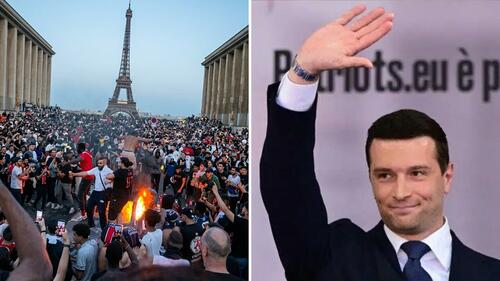
Paris Riots After PSG Champions League Win Drive Bardella to Record Popularity, Exposing Europe's Accelerating Realignment on Immigration and Security
Post-PSG Champions League riots in Paris (nearly 900 arrests, widespread violence) have propelled National Rally leader Jordan Bardella to a record 47% popularity in Verian/Le Figaro polling, highlighting public frustration with immigration, security, and integration. This reflects a deeper European realignment where nationalist parties gain from linking urban disorder to failed multicultural policies, squeezing the center and challenging EU orthodoxies ahead of 2027 French and other continental votes.
The violent unrest that erupted across Paris and other French cities following Paris Saint-Germain's dramatic penalty-shootout victory over Arsenal in the 2026 UEFA Champions League final has provided fresh momentum to the country's right-wing surge. French authorities reported approximately 890 arrests, with hundreds of stores looted, vehicles torched, and around 180 police officers injured amid scenes that Jordan Bardella, president of the National Rally (RN), described as 'scenes of civil war' linked to failures in immigration policy and integration.[1][2]
A Verian poll published in Le Figaro Magazine, conducted in the immediate aftermath from May 31 to June 2, 2026, shows Bardella reaching a record 47% of respondents wanting him to play an important role in public life — a six-point jump in one month that places him well ahead of all other figures, including Marine Le Pen at 40%. This surge aligns with other recent polling indicating Bardella would prevail in a 2027 presidential runoff against centrist Édouard Philippe (52-48) and crush far-left leader Jean-Luc Mélenchon by massive margins.[3][4]
While the riots were triggered by football celebrations, Bardella and RN allies have successfully tied the disorder — disproportionately involving youths from immigrant-heavy suburban areas — to deeper failures in Macron-era governance on security, assimilation, and mass migration. Videos of harassment near landmarks like the Eiffel Tower amplified public outrage, mirroring patterns seen in prior French unrest. This is not merely a French story. It exposes an accelerating continent-wide political realignment: repeated high-profile incidents of urban violence are eroding faith in centrist and liberal parties' multicultural frameworks, boosting nationalist forces focused on sovereignty, border control, and cultural cohesion.
The dynamic creates what Politico termed Brussels' 'nightmare scenario' — a potential 2027 runoff between Bardella's Euroskeptic right and Mélenchon's radical left, both hostile to core EU integration principles on migration and economics. Centrist Emmanuel Macron's project appears squeezed, with mainstream conservatives also shifting rightward on these issues. Similar undercurrents are visible across Europe: the rise of Giorgia Meloni in Italy, gains by Geert Wilders in the Netherlands, AfD's resilience in Germany, and tightening policies in Sweden and Denmark all reflect voter prioritization of security and identity over previous orthodoxies.[2]
Deeper analysis reveals structural drivers others often miss. Decades of EU freedom-of-movement policies combined with uneven integration have produced parallel societies in many urban zones, where crime and cultural clashes periodically ignite. Public tolerance has limits; each riot cycle shifts the Overton window rightward, making once-fringe positions on deportation, asylum reform, and pausing immigration mainstream. Bardella, the telegenic 30-something face of a 'rebranded' RN, benefits from being untainted by past extremism charges while projecting competence on law-and-order. His edge over Le Pen in some hypotheticals suggests voters see him as more electable to deliver the realignment.
Macron's interior minister and others now openly acknowledge Mélenchon's far-left surge as the primary obstacle to containing the right, underscoring how polarization benefits populists. With 2027 elections approaching and European Parliament dynamics shifting, these French tremors signal broader continental pressure for policy pivots on immigration — potentially forcing even centrist EU institutions toward stricter enforcement to retain legitimacy. The riots were not inevitable, but the political reaction to them appears to be.
[LIMINAL]: Bardella's post-riot surge indicates immigration and security concerns are now decisive electoral drivers across Europe, likely accelerating nationalist gains in multiple countries by 2028 and forcing EU-level concessions on border enforcement to avert further fragmentation.
Sources (5)
- [1]Baromètre politique Verian pour Le Figaro Magazine - Juin 2026(https://www.veriangroup.com/fr/news-and-insights/barom%C3%A8tre-politique-verian-pour-le-figaro-magazine-juin-2026)
- [2]French football violence fires up far right ahead of World Cup(https://www.politico.eu/article/far-right-france-football-violence-world-cup-tensions/)
- [3]PSG celebrations marred by violence as French authorities report 890 arrests(https://www.rfi.fr/en/france/20260601-psg-celebrations-marred-by-violence-as-french-authorities-report-890-arrests)
- [4]France’s Far Right Has 2 Leaders. They Don’t Always Have One Voice.(https://www.nytimes.com/2026/05/29/world/europe/france-presidential-election-le-pen-bardella.html)
- [5]France arrests hundreds of rioters nationwide as PSG win Champions League(https://www.aljazeera.com/sports/2026/5/31/france-arrests-hundreds-of-rioters-nationwide-as-psg-win-champions-league)