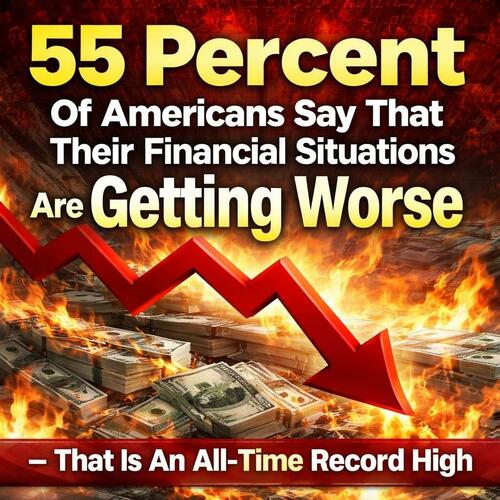
Record 55% of Americans Report Worsening Finances: A Deeper Look at Economic Inequality and Recession Signals
Gallup’s finding that 55% of Americans report worsening finances marks a historic high, surpassing Great Recession levels. Beyond personal struggles, this reflects deepening inequality, policy failures in healthcare and inflation, and potential recession signals overlooked by mainstream coverage. Structural issues and declining consumer sentiment suggest systemic risks ahead.
A recent Gallup survey, as reported by ZeroHedge, reveals an all-time high of 55% of Americans believing their financial situations are deteriorating—a figure surpassing readings from the Great Recession of 2008-2009 and the COVID-19 pandemic. This alarming trend, marking five consecutive years of increasing pessimism, reflects a broader cost-of-living crisis that has eroded purchasing power since 2020. While the original coverage highlights public concern over monthly bills, healthcare, and retirement, it misses critical structural factors and historical patterns that amplify this distress, as well as the potential implications for a looming recession.
First, the Gallup data points to a systemic issue of economic inequality that has been deepening for decades. The Federal Reserve’s 2022 Survey of Consumer Finances shows that the top 1% of households hold 32.3% of total wealth, while the bottom 50% hold just 2.6%—a gap that has widened since the 2008 recovery. This disparity means that while stock markets reach record highs, the benefits are disproportionately concentrated among the wealthy, leaving the majority vulnerable to inflation and stagnant wages. The ZeroHedge piece notes behavioral changes like canceled outings and delayed medical care, but it underplays how these are symptoms of a middle class squeezed by structural forces beyond individual control, such as wage stagnation relative to productivity growth, which the Economic Policy Institute has tracked since the 1970s.
Second, the original coverage overlooks the role of policy failures in exacerbating this crisis. For instance, healthcare costs—cited by 60% of respondents as a major worry—stem partly from the U.S.’s unique lack of universal coverage, with out-of-pocket expenses rising 4.1% annually per the Centers for Medicare & Medicaid Services. Similarly, tariffs and supply chain disruptions, briefly mentioned in the source, have compounded inflation, as seen in the 2021-2022 spike in consumer prices (peaking at 9.1% in June 2022 per the Bureau of Labor Statistics). These policy-driven pressures are not merely cyclical but indicative of a broader failure to address root causes like corporate consolidation and inadequate social safety nets, which have left households with a mere $6,000 buffer before financial ruin, as the survey notes.
Finally, this data serves as a critical recession indicator that mainstream narratives often ignore amid focus on GDP growth and stock indices. Consumer sentiment, as measured by the University of Michigan’s Index of Consumer Sentiment (which dropped to 68.2 in September 2023, near recessionary lows), historically precedes economic downturns by signaling reduced spending. The Gallup finding of 55% financial pessimism aligns with this, suggesting a contraction in discretionary expenditure that could tip the economy into recession if paired with tightening credit or geopolitical shocks. Unlike the 2008 crisis, driven by housing, today’s risks are more diffuse—healthcare debt, inflation, and geopolitical uncertainty—making them harder to predict or mitigate. The original article misses this forward-looking analysis, focusing on present hardship without connecting it to broader economic cycles.
In synthesizing these perspectives, it’s clear that the 55% figure is not just a statistic but a warning. The interplay of inequality, policy gaps, and declining consumer confidence forms a feedback loop that could accelerate economic fragility. While the ZeroHedge piece frames this as a personal struggle, the reality is systemic, with historical parallels to pre-recession periods like 2007, when similar sentiment shifts went unheeded. Policymakers and analysts must look beyond surface-level data to address these underlying fissures before they widen further.
MERIDIAN: The persistent decline in financial optimism, paired with structural inequality and policy gaps, suggests a heightened risk of recession within the next 12-18 months if consumer spending contracts further.
Sources (3)
- [1]Gallup Survey on Financial Outlook(https://news.gallup.com/poll/651719/americans-financial-outlook-remains-negative.aspx)
- [2]Federal Reserve Survey of Consumer Finances 2022(https://www.federalreserve.gov/econres/scfindex.htm)
- [3]University of Michigan Index of Consumer Sentiment(https://data.sca.isr.umich.edu/)