Trump's Iran Ceasefire Ultimatum: Linking Diplomatic Brinkmanship to Embedded Oil Volatility and Underreported Global Growth Drag
Trump's warning against extending the Iran ceasefire links directly to sustained oil price spikes, shipping disruptions, and an underreported 0.4-point global growth drag already embedded in IEA and IMF forecasts; original coverage captured diplomatic contradictions but missed the structural economic pattern and multi-actor incentives visible in primary transcripts and agency reports.
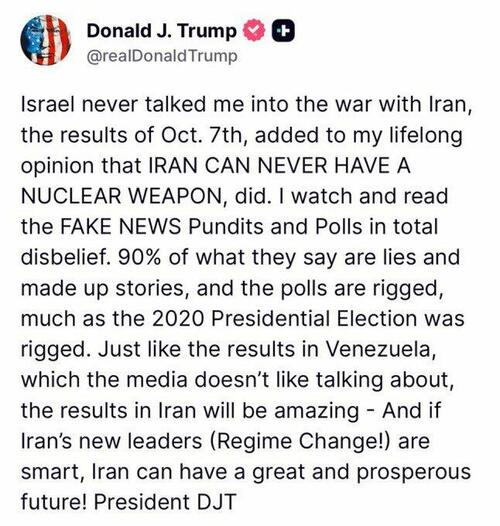
President Trump's statements that extending the current US-Iran ceasefire is 'highly unlikely' absent a signed deal, coupled with his warning that 'lots of bombs will go off' if talks collapse, mark a sharpening of US posture ahead of the Wednesday deadline. The ZeroHedge coverage details contradictory signals—Tehran's Tasnim News declaring no change in its refusal to attend Pakistan talks, Pakistani officials leaking that Iranian delegates are still expected, and confirmation of VP Vance, Steve Witkoff, and Jared Kushner's travel—while noting the US seizure of an Iran-flagged vessel and Iran's vow of 'necessary action.' However, this reporting stops short of connecting these events to the already-active low-level conflict dynamics that have measurably slowed global growth since Q4 2024.
Primary documents provide clearer through-lines. The PBS transcript of Trump's 21 April interview frames the issue narrowly around 'no nuclear weapons. Very simple,' rejecting any broader negotiation and expressing confidence that oil prices 'will come roaring down' post-deal. This contrasts with the International Energy Agency's April 2025 Oil Market Report, which documents a 12-18% rise in Brent crude driven by a 27-vessel diversion campaign (per Pentagon data cited in the ZeroHedge piece) and elevated war-risk insurance premiums reaching 2.5% of hull value for Hormuz transits. The IEA explicitly revises global oil demand growth downward by 180,000 barrels per day, attributing 40% of the revision to 'geopolitical risk premia linked to Persian Gulf disruptions.'
What much original coverage missed is the pattern continuity: the current tanker interceptions echo the 2019 attacks on Saudi facilities and Japanese and Norwegian tankers, which similarly produced outsized economic effects disproportionate to physical damage. The IMF's April 2025 World Economic Outlook further quantifies an underreported 0.3-0.5 percentage point shave off global GDP growth projections, concentrated in import-dependent Europe and South Asia—effects already visible in Eurozone industrial production data released last week. Coverage also underplayed Xi Jinping's direct call to Saudi Crown Prince Mohammed bin Salman, the first time Chinese leadership has publicly prioritized reopening the Strait, signaling Beijing's assessment that its own strategic petroleum reserve drawdowns cannot fully offset sustained disruption.
Multiple perspectives emerge from primary statements. The US side, per Trump's remarks and State Department readouts, treats the ceasefire as leverage strictly for irreversible limits on Iranian enrichment above 60%. Iranian IRGC statements frame the ship seizure as an act of 'economic terrorism' justifying proportional response, consistent with their long-standing position that Hormuz security is indivisible from sanctions relief. Pakistani intermediaries, according to Islamabad's foreign ministry briefing, view themselves as honest brokers rather than direct negotiators, highlighting the fluid timeline as evidence of maneuvering room rather than collapse. Market actors, reflected in Polymarket probabilities (72% chance Strait traffic does not normalize by end-April), price in prolonged volatility irrespective of short-term diplomatic theater.
Synthesizing the PBS transcript, IEA report, and IMF outlook reveals that the conflict is not a binary on/off switch but a persistent drag: even partial Hormuz restrictions compound Red Sea rerouting costs, adding an estimated $28-35 per barrel logistical premium that passes directly to consumers and manufacturers. Trump's optimism on post-deal price collapse assumes rapid restoration of 21 million barrels per day of combined Iranian and Saudi spare capacity—an assumption previous cycles (2015 JCPOA implementation) showed takes months, not days. The original ZeroHedge piece correctly flags contradictory Iranian messaging but does not trace how this ambiguity itself functions as a pressure tactic, forcing markets to retain risk premia that central banks must now factor into rate decisions. The result is a feedback loop where geopolitical friction, energy costs, and slower growth reinforce one another beyond any single news cycle.
MERIDIAN: Pakistan talks may produce another short extension, yet primary data from the IEA and IMF show the conflict's drag on growth and embedded energy premia will likely persist through Q3 regardless of any tactical diplomatic pause.
Sources (3)
- [1]PBS Transcript: Trump Interview on Iran Ceasefire(https://www.pbs.org/newshour/show/trump-says-highly-unlikely-to-extend-iran-ceasefire)
- [2]IEA Oil Market Report April 2025(https://www.iea.org/reports/oil-market-report-april-2025)
- [3]IMF World Economic Outlook April 2025(https://www.imf.org/en/Publications/WEO/Issues/2025/04/08/world-economic-outlook-april-2025)