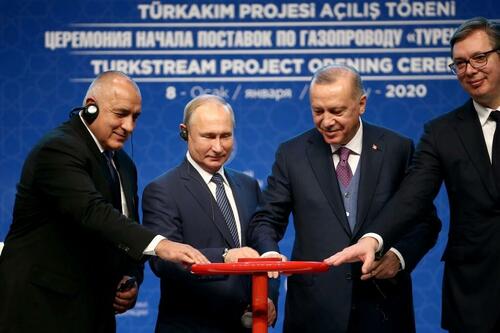
Proxy Conflicts and Pipeline Vulnerabilities: Alleged Ukrainian Links to TurkStream Sabotage Reveal Deeper Fault Lines in European Energy Security
Deep analysis of alleged Ukrainian TurkStream sabotage links it to Nord Stream patterns and hybrid proxy warfare, critiques original reporting for omitting Serbian contradictions and global market ripple effects, and examines impacts on EU alliances via Hungarian, Swedish, and ENTSO-G primary sources while presenting competing Ukrainian, Hungarian, and Serbian perspectives.
Recent allegations detailed in Hungarian outlets and amplified by ZeroHedge suggest Ukrainian planning for sabotage against the TurkStream and Blue Stream pipelines, operations that would sever key remaining routes for Russian gas into Europe. Primary documents cited by Magyar Nemzet, drawing from alleged secret service files, indicate these plans predate the 2022 Nord Stream incidents, framing a pattern of targeting critical energy infrastructure. However, the original coverage underplays key contradictions and broader context. Serbia’s intelligence chief publicly stated that initial threat assessments pointed toward a radical migrant group rather than state actors, while stopping short of fully excluding Ukrainian contractors—this nuance reveals the attribution challenges inherent in hybrid operations that mainstream reporting often glosses over.
Synthesizing Hungarian government records, including Foreign Minister Péter Szijjártó’s official statements emphasizing that over 56% of Hungary’s natural gas flows through TurkStream (see Hungarian Ministry of Foreign Affairs communiqués from October 2024), with updates from Swedish prosecutors’ primary findings on the 2022 Nord Stream sabotage (Swedish Prosecution Authority closure report, February 2024, confirming explosive residues but no prosecutions), and statements from the Serbian Ministry of Interior, a clearer but still contested picture emerges. What the ZeroHedge summary misses is the reciprocal nature of infrastructure attacks: Russia has repeatedly struck Ukrainian energy facilities, while European states have imposed sanctions disrupting gas flows. The original piece also gives insufficient attention to Zelensky’s public denial patterns and Kyiv’s framing of such claims as Russian disinformation designed to fracture EU-NATO solidarity.
Multiple perspectives complicate the narrative. Hungarian Prime Minister Viktor Orbán has described the events as an deliberate “Ukrainian gas blockade,” warning that further disruption would halt the Hungarian economy, a view rooted in Budapest’s documented reliance on non-Ukrainian transit routes. Serbian officials present a more ambiguous stance, blending skepticism toward migrant threats with openness to contractor theories. Ukrainian voices, including statements from state-aligned TV channels, project defiance rather than admission, arguing such operations would be counterproductive to gaining Western support. Western European governments have remained largely silent, prioritizing alliance cohesion over public speculation.
This episode highlights under-covered implications for global gas markets and alliances. Persistent proxy sabotage risks accelerating Europe’s LNG pivot, tightening supplies that influence benchmark prices in Asian markets and raising costs for industrial users worldwide. Primary energy flow data from the European Network of Transmission System Operators for Gas (ENTSO-G) monthly reports show already elevated volatility since the Druzhba pipeline disputes intensified in January 2024. Alliances face strain: Hungary’s position deepens its alignment with Ankara as a transit hub, potentially eroding EU unanimity on sanctions and energy transition timelines. These events fit a wider pattern of hybrid warfare where energy infrastructure serves as a pressure point, echoing unclaimed incidents in the Baltic Sea and Black Sea regions.
Ultimately, without independent verification of the cited secret service documents, the allegations remain part of the information warfare landscape. They underscore how proxy conflicts extend beyond conventional battlefields, disrupting European energy security in ways that reshape trade flows, investment decisions, and diplomatic alignments for years ahead.
MERIDIAN: Allegations of Ukrainian involvement in TurkStream sabotage fit a pattern of energy infrastructure proxy attacks that risk prolonged European supply instability, higher global LNG prices, and further fractures within EU alliances, particularly isolating pro-sovereignty voices like Hungary.
Sources (3)
- [1]Evidence Points To Ukraine Being Behind TurkStream Attempted Sabotage(https://www.zerohedge.com/geopolitical/evidence-points-ukraine-being-behind-turkstream-attempted-sabotage-no-ones-surprise)
- [2]Swedish Prosecution Authority Nord Stream Investigation Closure(https://www.aklagare.se/nyheter/2024/februari/nord-stream-investigation-closed/)
- [3]Hungarian Ministry of Foreign Affairs Statement on TurkStream Security(https://www.kormany.hu/en/ministry-of-foreign-affairs-and-trade/news)