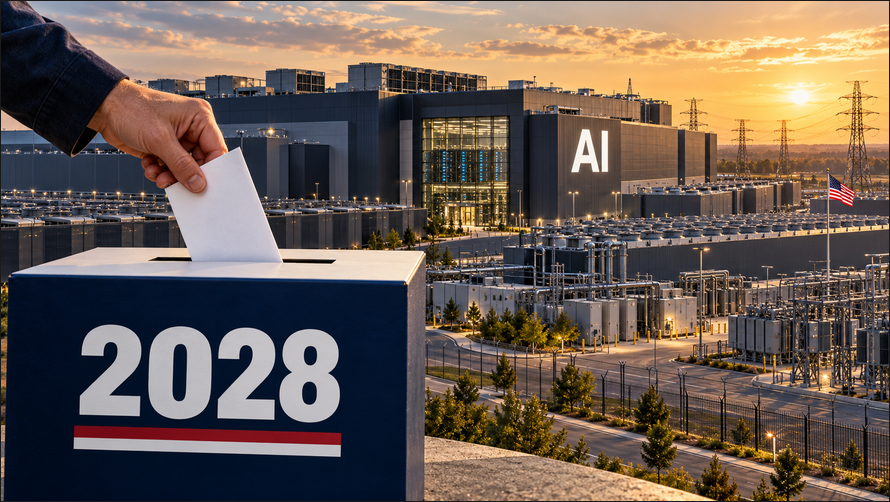
AI Infrastructure Backlash Emerges as Potential Flashpoint for 2028 Presidential Race
Box CEO Aaron Levie predicts the 2028 election will center on AI amid public opposition to data centers, backed by Fox News and Marquette polls showing 71% local opposition and cost concerns; Trump admin pushes pro-AI infrastructure policies.
Silicon Valley leaders are signaling that artificial intelligence could dominate the 2028 U.S. presidential campaign, driven by public skepticism over the energy-hungry data centers required to power the technology. Box CEO Aaron Levie, speaking on the Andreessen Horowitz podcast in late September 2026, stated that 'the next election will 100% be a referendum on AI' and that '2028 is the AI election.' He noted the challenge of crafting a compelling pro-AI narrative compared to simpler opposition messages. Fellow guest Steven Sinofsky added that critics have shaped the debate's language around terms like 'pause,' 'swarms,' and 'rogue.'
These comments align with recent polling data showing widespread resistance. A Fox News national survey conducted September 11-14, 2026, found that 71% of registered voters oppose building an AI data center in their area, with 46% strongly opposed; only 26% support it locally, though 52% favor remote sites. A national Marquette Law School Poll from early September 2026 reported that 71% of Americans believe the costs of data centers outweigh the benefits, versus 29% who see net gains. The same survey indicated 64% view AI as bad for society.
The Trump administration has pursued policies to accelerate AI infrastructure while addressing voter concerns, including a National Policy Framework for Artificial Intelligence aimed at streamlining federal permitting for data centers and energy projects without raising residential electricity rates. Tech firms have signed onto related commitments to fund their own power generation. However, the polls suggest these efforts face headwinds amid broader worries over electricity costs, water use, and land impacts.
This dynamic reflects a classic 'not in my backyard' tension amplified by rapid technological scaling, with potential implications for midterm debates and long-term political positioning on innovation versus regulation.
LIMINAL: Public resistance to AI infrastructure could force candidates to prioritize local energy safeguards and transparent cost allocation, potentially slowing national buildout timelines while elevating state-level permitting fights.
Sources (5)
- [1]a16z Podcast: Aaron Levie, Steven Sinofsky & Martin Casado on AI Agents(https://www.youtube.com/watch?v=TLJNJDf2XGo)
- [2]Fox News Poll: Voters question whether AI’s promise outweighs its risks(https://co.headtopics.com/news/fox-news-poll-voters-question-whether-ai-s-promise-88028926)
- [3]Marquette Law School Poll: Data centers and industrial development(https://law.marquette.edu/poll/2026/09/16/mlspsc35-1/)
- [4]Fact Sheet: President Donald J. Trump Ensures a National Policy Framework for Artificial Intelligence(https://www.whitehouse.gov/fact-sheets/2025/12/fact-sheet-president-donald-j-trump-ensures-a-national-policy-framework-for-artificial-intelligence/)
- [5]Ensuring a National Policy Framework for Artificial Intelligence(https://thefederalregister.org/documents/2025-23092/ensuring-a-national-policy-framework-for-artificial-intelligence)