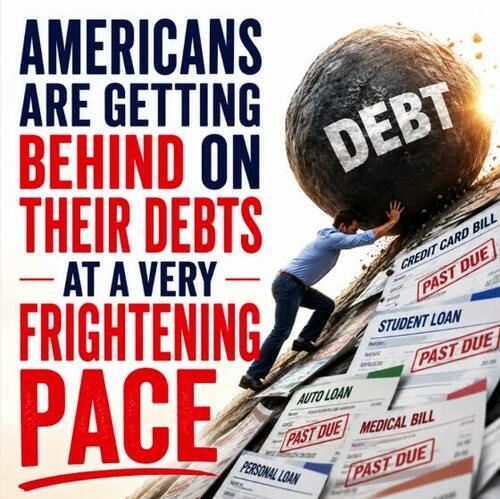
Rising Consumer Delinquencies and Foreclosures Reveal Hidden Strain on U.S. Households Amid Official Resilience Narrative
NY Fed and ATTOM data show U.S. household debt at $18.8T with rising delinquencies in student loans (10.3%), credit cards, and auto loans, plus an 18% YoY jump in foreclosures, pointing to widespread financial strain downplayed by mainstream economic resilience narratives and reminiscent of pre-2008 warning signs.
Official data from the Federal Reserve Bank of New York confirms U.S. household debt reached $18.8 trillion in Q1 2026, continuing a decades-long surge from just $1.4 trillion in 1980. While aggregate delinquency rates held relatively steady at 4.8% of outstanding debt, underlying figures show troubling increases across key consumer categories. Student loan delinquency rates have climbed to 10.3%, with serious delinquencies (90+ days past due) hitting 10.9% — levels not seen since before the COVID payment pause. Credit card and auto loan transition rates into delinquency remain elevated, with some metrics approaching those observed in the lead-up to the 2008 financial crisis.[1][2]
Complementing this, ATTOM Data Solutions reported 42,430 foreclosure filings in April 2026, an 18% increase from the previous year. Foreclosure starts rose 12% year-over-year, with completed repossessions up 42%. This echoes the early warning signs of mounting homeowner distress that preceded the Great Recession, when foreclosure waves signaled housing market weakness well before the broader crash.[3][4]
These trends occur against a backdrop of persistent cost-of-living pressures, where many households are stretched thin despite headline claims of economic strength. Mainstream reporting often highlights stable overall delinquency rates and modest debt growth of just $18 billion in the quarter, downplaying category-specific spikes in auto loans, credit cards, and student debt that disproportionately affect working families. Connections to broader indicators — such as Seattle's near-doubling of homes for sale and modest price declines — suggest regional stress from layoffs, unaffordability, and migration may foreshadow national softening. Unlike 2008, the risks today center on consumer revolving and installment debt rather than subprime mortgages, yet the pattern of deteriorating repayment capacity under inflation and high interest rates is strikingly similar.
Analysts note that while lenders have tightened standards, the combination of record debt loads and rising serious delinquencies (particularly student loans now returning to collections) signals that millions of households are reaching breaking points. This undercurrent of financial fragility, if unaddressed, risks cascading into reduced consumer spending — the primary engine of U.S. GDP — potentially accelerating a downturn that official optimism currently overlooks.
LIMINAL: Accelerating delinquencies in everyday consumer debts are quietly eroding household balance sheets, likely triggering a sharper consumer spending pullback and exposing the fragility behind 'resilient economy' claims by late 2026.
Sources (4)
- [1]Household Debt Balances Rise Slightly as Delinquency Rates Remain Stable(https://www.newyorkfed.org/newsevents/news/research/2026/20260512)
- [2]ATTOM April 2026 U.S. Foreclosure Market Report(https://www.attomdata.com/news/market-trends/foreclosures/april-2026-foreclosure-market-report/)
- [3]New York Fed: Household Debt Holds at $18.8T in Q1(https://bankingjournal.aba.com/2026/05/new-york-fed-household-debt-holds-at-18-8t-in-q1/)
- [4]U.S. Household Debt Hits $18.8 Trillion as Student Loan Delinquencies Surge(https://thedeepdive.ca/us-household-debt-hits-18-8-trillion-as-student-loan-delinquencies-surge/)