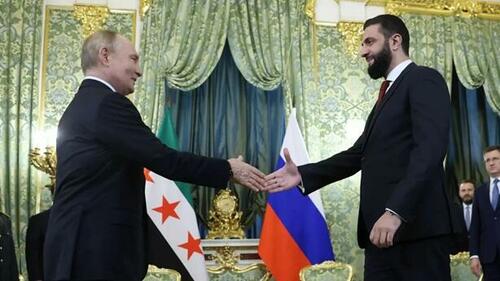
Russia's Enduring Oil Leverage in Post-Assad Syria: A Strategic Foothold Undermining Western Realignment
Reuters reporting and corroborating analyses confirm a 75% surge in Russian oil deliveries to Syria (now ~60k bpd) post-Assad, cementing Moscow's leverage despite Damascus's Western pivot. This exposes the primacy of energy realities over political realignments, sustaining Russian military presence and complicating U.S. influence while highlighting multipolar alliances that could trigger renewed sanctions and regional tensions.
Despite the dramatic fall of Bashar al-Assad in December 2024 and the subsequent pivot by Syria's new leadership under Ahmad al-Sharaa toward Washington, the EU, and even Israel, Moscow has quietly solidified its position as Damascus's primary oil supplier. According to detailed vessel tracking and official data analyzed by Reuters, Russian crude shipments to Syria have surged 75% this year to approximately 60,000 barrels per day, making Russia the dominant provider in a country where domestic output languishes far below demand.[1][2]
This continuity persists even as the new Syrian authorities have cracked down on Palestinian factions at U.S. urging, engaged in talks with Israel, and been reframed by Washington as partners against ISIS—moves that led to the lifting of most American sanctions. Yet economic realities bite harder than diplomatic rhetoric. Iran, the former top supplier and Assad ally, has stepped back, leaving a vacuum that Russian tankers—many under Western sanctions—have filled, arriving at ports like Baniyas on an almost weekly basis. Last year, Russia delivered 16.8 million barrels; the pace has only accelerated.[3]
What mainstream coverage frames as pragmatic economics reveals a deeper geopolitical pattern: the limits of regime-change engineering and the primacy of energy dependencies in a multipolar order. Russia's willingness to supply despite its prior heavy investment in propping up Assad demonstrates strategic patience. Negotiations have allowed Moscow to retain military bases at Tartous and Hmeimim, preserving projection power in the Eastern Mediterranean. This oil lifeline functions as both economic stabilizer for Damascus and a subtle veto on full Western integration. As analyst Karam Shaar noted, unresolved Ukraine tensions could prompt Washington to pressure Syria to halt Russian imports 'overnight,' exposing the new government's precarious position.[1]
Connections missed in standard reporting include how this mirrors broader erosion of Western sanctions efficacy. Like India's and China's continued Russian energy purchases, Syria's trade—facilitated through opaque shipping networks—highlights alternative financial and logistical channels bypassing dollar dominance. It also underscores a heterodox truth of international relations: ideological 'pivots' toward liberal democracy or anti-extremism rhetoric falter against immutable needs for fuel to power refineries, electricity, and reconstruction. With Syria's largest field producing a mere 5,000 bpd, dependence on Moscow (and lingering sanctioned networks) risks entrenching Russian and potentially Chinese influence in postwar contracts, undermining efforts to pull Damascus fully into a Western orbit.[4]
This dynamic carries escalation risks. Renewed secondary sanctions could destabilize the fragile post-HTS order, alienate a population desperate for stability, or force Syria back toward adversarial networks. Far from a peripheral trade story, Russia's oil pivot illustrates the enduring architecture of great-power competition: energy as the ultimate currency of influence, where military victories and political rebrandings yield to tanker routes and port calls. In the emerging multipolar landscape, such dependencies may prove more decisive than diplomatic declarations, accelerating fractures in the post-2024 Middle East order.
Geopolitical Forecaster: Syria's structural dependence on Russian oil will likely preserve Moscow's strategic assets in the Levant for years, blunting Western attempts at a clean regional reset and raising the odds of secondary sanctions that could fracture the new Damascus government or accelerate broader anti-hegemonic trade blocs.
Sources (4)
- [1]Exclusive-Syria relies on Russia's oil despite pivot to the West(https://www.reuters.com/world/middle-east/syria-relies-russias-oil-despite-pivot-west-2026-05-01/)
- [2]Syria Still Leans on Russia for Oil Supply(https://oilprice.com/Latest-Energy-News/World-News/Syria-Still-Leans-on-Russia-for-Oil-Supply.html)
- [3]Syria relies on Russia's oil despite pivot to the West(https://www.jpost.com/middle-east/article-894855)
- [4]Russia boosts Arctic oil supplies to Syria, LSEG and source data showed(https://www.reuters.com/business/energy/russia-boosts-arctic-oil-supplies-syria-lseg-source-data-showed-2025-05-30/)