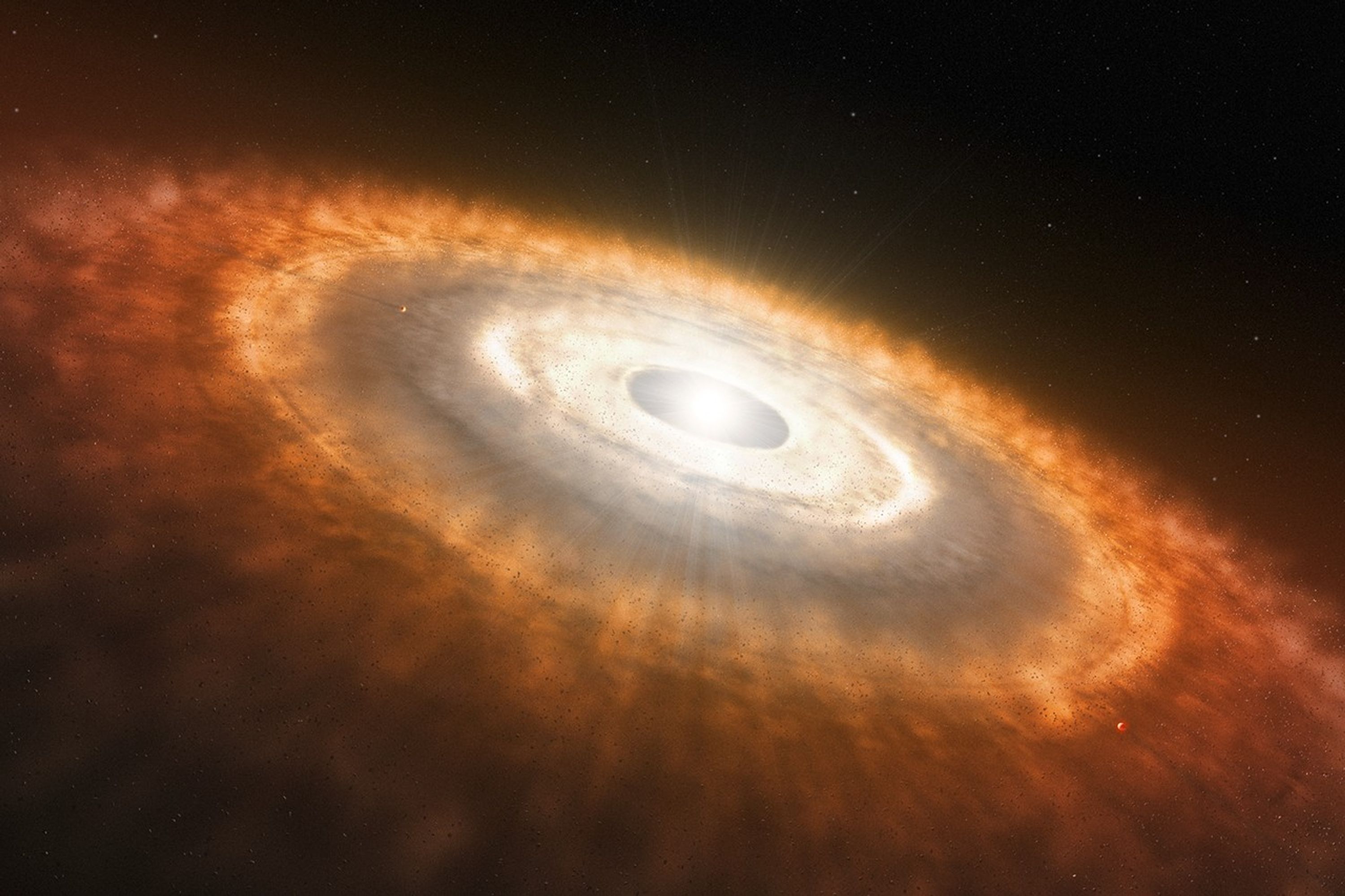
Jupiter's Gravitational Barrier: How Meteorite Chemistry Reveals a Dynamic Delivery System for Life's Elements on Early Earth
Jupiter's formation created a chemical filter that delivered key life elements to early Earth via altered planetesimal ratios, advancing beyond simple chondrite delivery models with implications for exoplanet habitability.
The NASA-supported study in Science Advances reconstructs phosphorus-nitrogen ratios from iron meteorites (first-generation planetesimals) and chondrites (second-generation) using lab experiments and geochemical models, showing Jupiter's growth reversed P/N gradients and enriched the inner solar system. This challenges the dominant late-veneer narrative that relies solely on outer solar system chondrites delivering volatiles late in Earth's accretion. Instead, it highlights an earlier, Jupiter-modulated mechanism where outward material flows initially boosted outer P/N before the planet's migration and mass blocked further transport, concentrating essentials inward. Related work, such as the 2021 Nature Astronomy analysis of enstatite chondrites (Savage et al.), supports inner solar system sources for volatiles, while a 2023 Icarus paper on giant planet migration (Raymond & Izidoro) extends this pattern to exoplanetary systems where gas giants may similarly gate habitability. The original coverage underplays model limitations—reliance on surviving meteorite fragments and assumptions about planetesimal formation timing—while missing broader astrobiology implications: comparable architectures in other systems could predict which rocky worlds receive sufficient N and P for prebiotic chemistry, informing targets like those observed by JWST.
HELIX: Gas giant formation acts as a chemical gatekeeper across solar systems, potentially explaining why some rocky planets inherit the precise elemental ratios needed for life while others do not.
Sources (3)
- [1]Primary Source(https://science.nasa.gov/science-research/planetary-science/astrobiology/nasa-finds-new-way-earth-may-have-received-elements-needed-for-life/)
- [2]Related Source(https://www.science.org/doi/10.1126/sciadv.adf4893)
- [3]Related Source(https://www.nature.com/articles/s41550-021-01495-w)