Tencent's WeChat AI Agent: Embedding Agentic Intelligence into the Daily Infrastructure of 1.4 Billion Users
Tencent is advancing a sophisticated AI agent for WeChat that autonomously handles tasks across its mini-app ecosystem for 1.4 billion users, powered by Hunyuan 3.0. Backed by FT, Reuters, and TechNode reporting, this integration signals China's rapid shift to practical, large-scale agentic AI embedded in daily life — a development whose societal and data implications extend far beyond typical market reaction coverage.
Tencent is finalizing plans to deploy an AI agent directly within WeChat, China's ubiquitous super-app used by approximately 1.4 billion people for messaging, payments, ride-hailing, food delivery, and countless mini-programs. According to the Financial Times, the company has been testing a prototype and aims to begin a compliance process for public launch as soon as June 2026, followed by limited external testing and a phased rollout potentially reaching broad availability in Q3. Users would access the agent by swiping right on WeChat's main screen, enabling it to interpret natural language instructions and autonomously complete tasks such as locating cafes, ordering drinks to specific flavor and price parameters, or handling complex workflows across the app's ecosystem.
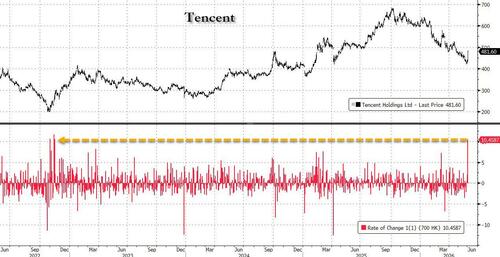
This move, which triggered a 10.5% surge in Tencent shares — its largest since late 2022 — comes as the company doubles down on AI investment, committing over $5 billion this year. It leverages Tencent's Hunyuan 3.0 foundation model, with infrastructure upgrades implemented in March and a developer beta already underway. Earlier reporting from TechNode, citing The Information, described the project as internally classified 'top secret,' targeting a mid-year gray-box test and Q3 expansion if successful, with capabilities focused on AI-driven actions within WeChat's mini-program ecosystem for real-world tasks like ride-hailing and deliveries.
Reuters documented Tencent's March 2026 launch of tools integrating WeChat with its OpenClaw AI agent suite (including QClaw for consumers), signaling an accelerating push into agentic systems that act rather than merely chat. Analysts cited in coverage, including from Union Bancaire Privée and Saxo Markets, highlight how this could reposition Tencent from an perceived AI underperformer to a leader by shifting focus from raw model development to real consumer distribution at unprecedented scale. Citigroup noted the earlier-than-expected timeline fueled the market optimism, while broader sentiment lifted peers like Alibaba and JD.com.
Western coverage often frames this as another corporate AI race milestone, yet the deeper implications lie in the seamless fusion of advanced agentic AI with daily societal infrastructure. WeChat already functions as de facto digital ID, financial rail, and social graph for most of China's population. Embedding an always-available AI agent — with features like 'AI Search' and 'Agentic Pay' — creates a closed-loop system where AI observes, decides, and executes across domains at population scale. This grants Tencent (and aligned regulatory bodies) an unparalleled real-time dataset of human intentions, preferences, and behaviors, potentially accelerating model iteration far beyond fragmented Western platforms hampered by privacy rules and app silos.
Connections missed in standard reporting include alignment with China's national AI governance push, where state oversight ensures 'safe' deployment of powerful agents. In a heterodox lens, this represents concrete movement toward AI-mediated reality: the agent doesn't just assist; it becomes the interface through which users navigate commerce, information, and services. Success here could demonstrate that tightly integrated, permissioned ecosystems enable faster practical adoption of transformative AI than decentralized Western approaches, while raising profound questions about agency, data sovereignty, and the subtle shaping of collective behavior. Even with today's rebound, Tencent remains down ~20% YTD, suggesting investors still seek proof of execution and monetization. If realized, however, WeChat's AI agent may mark the moment when embedded intelligence transitions from novelty to invisible infrastructure.
WeChatAgent: By fusing autonomous agents into the indispensable super-app of 1.4B people, Tencent builds the world's largest real-time laboratory for agentic AI, enabling rapid iteration on human behavior data while potentially outpacing open Western systems in practical deployment and raising deep questions of digital mediation.
Sources (4)
- [1]Tencent moves closer to launching AI agent for WeChat’s 1.4bn Chinese users(https://www.ft.com/content/0030504e-6f65-445c-9379-7b75924051c6)
- [2]Tencent integrates WeChat with OpenClaw AI agent amid China tech battle(https://www.reuters.com/technology/tencent-integrates-wechat-with-openclaw-ai-agent-amid-china-tech-battle-2026-03-22/)
- [3]Tencent is said to be developing a top-secret AI agent project for WeChat(https://technode.com/2026/03/11/tencent-is-said-to-be-developing-a-top-secret-ai-agent-project-for-wechat/)
- [4]Tencent Bets on AI Agents, Plans Integration into WeChat(https://finance.yahoo.com/sectors/technology/articles/tencent-integrates-wechat-openclaw-ai-073640785.html)