Trump's Hormuz Blockade: Economic Chokepoint Warfare Against China Disguised as Iran Conflict
Framing the 2026 Hormuz crisis as proxy economic warfare, this synthesis connects US blockade tactics to China's Malacca Dilemma and Pozsar's 'chokepoint portfolio' strategy, revealing great-power competition beyond mainstream regional narratives, with risks of backfire via Chinese diversification.
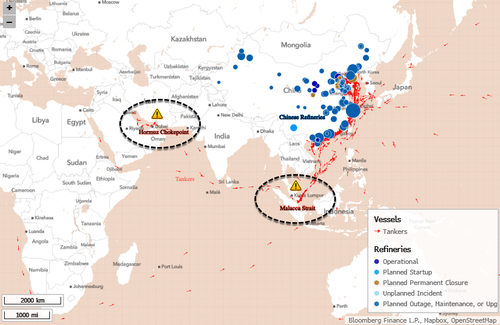
Mainstream coverage portrays the 2026 Strait of Hormuz crisis as a regional US-Iran confrontation aimed at curbing Tehran's oil revenues and 'blackmail' tactics. However, a deeper heterodox analysis reveals this as a calculated campaign of economic warfare targeting China's energy lifelines through critical maritime chokepoints. With roughly 80% of China's crude imports historically reliant on routes originating from the Persian Gulf, the US naval blockade directly disrupts supplies from Saudi Arabia, Iraq, UAE, and Iran itself—flows that must navigate not only Hormuz but downstream bottlenecks like the Strait of Malacca, a passage just 1.7 miles wide at its narrowest that has long haunted Beijing as its 'Malacca Dilemma.'
New York Times reporting details how the blockade risks upending an emerging US-China détente ahead of a Trump-Xi summit, with Beijing condemning the moves as 'dangerous and irresponsible' while facing interdiction threats to Chinese-flagged tankers. CNBC analysis highlights the spillover straining US ties with both China and India, as energy risks mount from the upstream Hormuz closure. Bloomberg notes Trump's explicit aim to choke Iranian exports to Asia, positioning the action as leverage before high-level talks with Xi.
What mainstream outlets miss is the broader pattern articulated by Zoltan Pozsar: the Trump administration is systematically assembling a 'portfolio of assets'—Hormuz, Venezuelan oil fields, the Panama Canal, and secondary Indonesian straits like Lombok, Makassar, and Sunda—to constrain China's access to cheap energy. BBC coverage confirms the blockade's focus on Iranian ports and tolls, yet 82% of Hormuz-transiting oil heads to Asian markets, primarily China. This connects proxy conflicts (US vs. Iran, Houthis in Bab el-Mandeb) to great-power competition, where 'regional instability' serves as cover for pressuring Beijing's refineries and forcing concessions.
Further connections emerge in secondary routes: disruption at Malacca or Singapore Strait would compound issues, pushing China toward costlier reroutes while the US leverages naval dominance in the Indo-Pacific. NDTV's examination of the 'Malacca Gambit' links Caracas-to-Hormuz-to-Malacca as a coherent strangulation strategy, though China's pipelines, strategic reserves, shadow fleet, and renewable transition reduce vulnerability—potentially accelerating de-dollarization, BRICS energy deals, and naval buildup. Reuters and Wikipedia entries on the crisis timeline underscore Iran's retaliatory closures and Trump's demands for Chinese assistance in reopening the strait, exposing the intertwined economic and military dimensions.
This heterodox lens suggests the blockade is less about Iranian regime change than reshaping global energy flows to 'level the playing field,' risking escalation into direct US-China maritime friction or unintended gifts to Beijing in legal precedents for its own chokepoint assertions near Taiwan.
LIMINAL: US chokepoint pressure on China via Hormuz and Malacca will accelerate Beijing's overland pipelines, renewable shift, and naval projection, deepening alliances with Russia-Iran and raising odds of Indo-Pacific flashpoints by 2027.
Sources (6)
- [1]Trump’s Blockade Risks Upending an Emerging Détente With China(https://www.nytimes.com/2026/04/14/us/politics/trump-iran-blockade-china.html)
- [2]Trump's Hormuz blockade tests U.S. ties with China and India(https://www.cnbc.com/2026/04/15/strait-hormuz-us-iran-blockade-china-india-relations-energy-risk-tensions.html)
- [3]Why and how is US blockading Iranian ports in Strait of Hormuz(https://www.bbc.com/news/articles/c5yv6xr6me3o)
- [4]Trump Risks Showdown With Xi Before Summit Over Hormuz Move(https://finance.yahoo.com/sectors/energy/articles/trump-hormuz-blockade-risks-showdown-105556921.html)
- [5]The Malacca Gambit: How China Oil-Choke Strategy Could Backfire On Trump(https://www.ndtv.com/world-news/caracas-to-hormuz-to-malacca-how-trump-is-trying-to-strangle-chinas-oil-11360453)
- [6]2026 Strait of Hormuz crisis(https://en.wikipedia.org/wiki/2026_Strait_of_Hormuz_crisis)