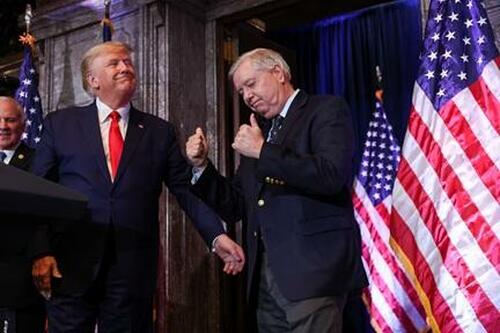
Graham's Call for Renewed Strikes on Iran Exposes Persistent Bipartisan Hawkishness and Cycles of US Middle East Escalation
Lindsey Graham's push for additional 'short but forceful' strikes on Iran amid a failing ceasefire and closed Strait of Hormuz exemplifies bipartisan US hawkishness, linking to historical patterns of escalation in the Middle East that prioritize military pressure over diplomacy and often lead to prolonged instability.
Senator Lindsey Graham's recent appearance on NBC's 'Meet the Press' underscores a familiar pattern in US foreign policy: the relentless push for military escalation when diplomatic efforts falter. Graham urged President Trump to pursue 'short but forceful' new strikes targeting Iran's energy infrastructure, described as its 'soft underbelly,' arguing that the ongoing closure of the Strait of Hormuz and stalled ceasefire only strengthen Tehran while inflicting pain on American consumers at the pump. He stated the status quo is 'hurting us all' and expressed readiness to 'lose my job' to prevent Iran from acquiring a nuclear weapon. This follows a reported 38-day US-led bombing campaign earlier in 2026 and a fragile Pakistan-mediated ceasefire in April that has repeatedly broken down over Hormuz access and nuclear talks.
Mainstream reporting from NBC News, Politico, and Fox News confirms Graham's comments align with Israeli strategic preferences and reflect broader bipartisan hawkishness that transcends party lines. Even within a Trump administration that campaigned on restraint, figures like Graham—long a proponent of aggressive postures toward Iran—frame limited strikes as the path to resolution. This 'one more escalation' mindset echoes neoconservative strategies from the Iraq War through interventions in Libya and Syria, where initial forceful actions to 'weaken' adversaries and install compliant regimes often entrenched quagmires, empowered proxies, and destabilized energy markets.
Connections others miss include the deep integration of Israeli objectives into US decision-making, with Graham's rhetoric mirroring calls from Tel Aviv for decisive action against Iran's nuclear sites and regional militias. The economic dimension is telling: disrupted Hormuz shipping has ripple effects on global oil prices, yet hawks prioritize 'putting Iran in a box' over immediate domestic fallout, revealing how foreign policy establishments consistently subordinate consumer costs to geopolitical containment. Official statements and analyses from the Wall Street Journal and AP further contextualize Iran's distrust of 'contradictory' US messaging and its reimposition of Strait restrictions, perpetuating a waiting game where each side tests the other's resolve.
This episode highlights larger systemic patterns—the influence of the military-industrial complex and enduring Washington consensus favoring kinetic solutions over sustained diplomacy. Rather than breaking cycles of conflict, such approaches risk drawing in external powers like China (with stakes in Iranian oil) and expanding the theater beyond bilateral US-Iran tensions. Graham's willingness to risk political capital signals that, despite shifting administrations, the default setting remains escalation when Iran refuses to yield on its core strategic programs.
Geopolitical Analyst: Graham's high-profile advocacy will likely intensify pressure on the Trump administration to resume limited strikes, driving up global energy prices in the near term while reinforcing long-term patterns of US military entanglement that weaken diplomatic off-ramps and heighten risks of broader regional war.
Sources (5)
- [1]Sen. Lindsey Graham says status quo in the Strait of Hormuz is 'hurting us all'(https://www.nbcnews.com/politics/politics-news/lindsey-graham-status-quo-strait-hormuz-iran-attacks-oil-gas-prices-rcna345542)
- [2]Graham calls for strikes on Iran’s energy infrastructure(https://www.politico.com/news/2026/05/17/lindsey-graham-strikes-iran-energy-infrastructure-00925550)
- [3]Sen Lindsey Graham floats idea of more US attacks against Iranian 'war machine'(https://www.foxnews.com/politics/sen-lindsey-graham-floats-idea-us-attacks-iranian-war-machine)
- [4]Sen. Graham Warns U.S. Military Action in Iran May Be Needed(https://www.wsj.com/livecoverage/iran-war-us-trump-2026/card/sen-graham-warns-u-s-military-action-in-iran-may-be-needed-IBWHNmjTKJtdJTs1yDll)
- [5]Iran reopens Strait of Hormuz, but threatens to close it again as the US maintains its blockade(https://apnews.com/article/us-iran-war-lebanon-israel-talks-pakistan-hormuz-17-april-2026-4bd5a29af608ecbd72356559b3c55d67)