Democracy's Stabilization Masks Enduring Structural Inequalities, Including Gender Gaps
EIU 2025 Democracy Index shows global stabilization with Nordic dominance and US decline; cross-referenced with gender gap data, it highlights how structural inequalities like gender disparities underpin democratic shortfalls beyond surface metrics.
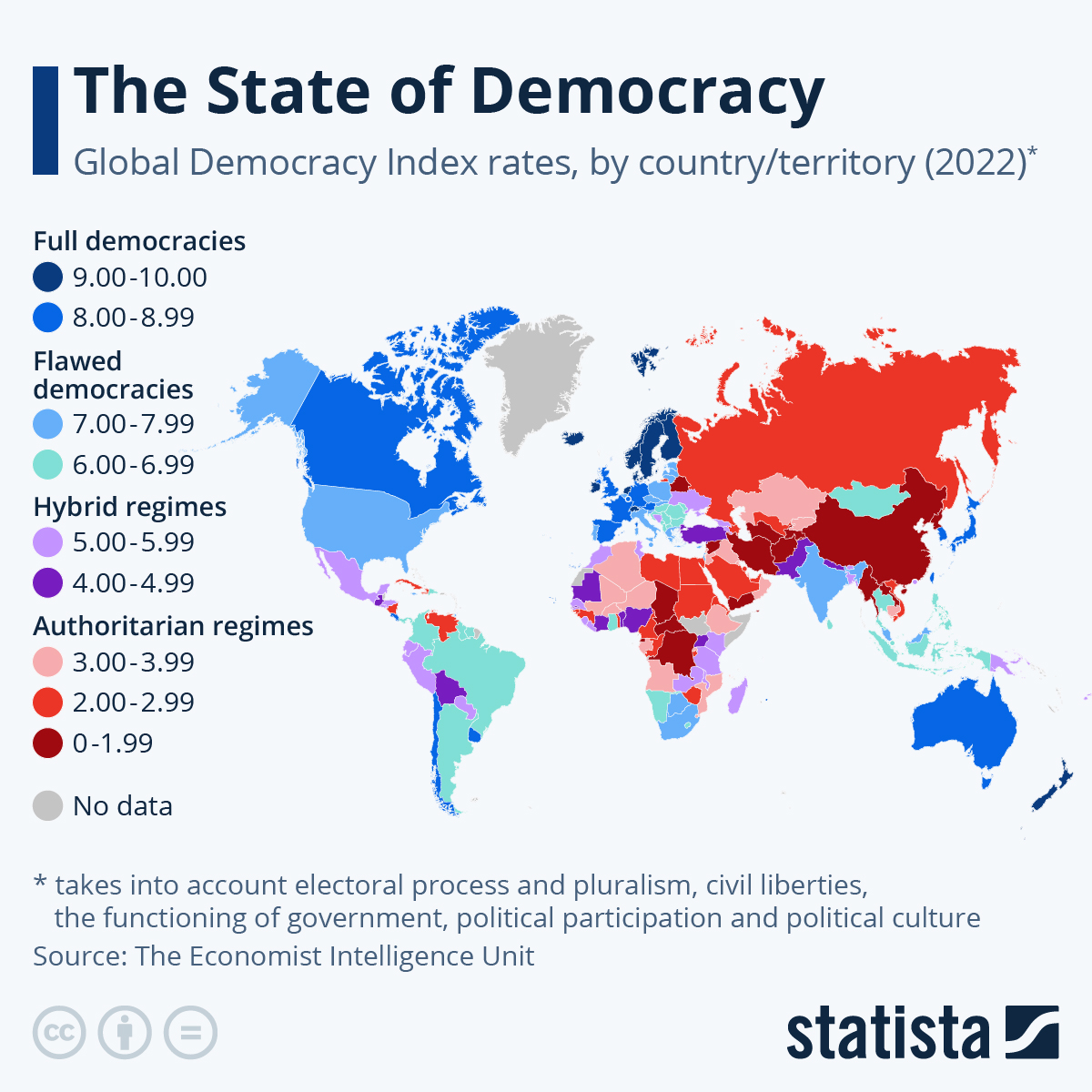
The Economist Intelligence Unit's Democracy Index 2025 reports a modest stabilization in global democratic scores after eight consecutive years of decline, with the average rising slightly to 5.19 out of 10 across 167 countries and territories. Nearly 75% of nations saw improvements or stability, though full democracies remain home to just 6.6% of the world's population while 39% live under authoritarian regimes. Nordic countries dominate the top ranks—Norway at #1, followed by New Zealand and Denmark—while the United States slipped further into 'flawed democracy' status (score 7.65, rank ~34), citing civil liberties erosion and polarization under the second Trump administration.[1][2]
Viewed through the lens of persistent gender inequality, these patterns reveal deeper structural connections. Top-performing democracies consistently overlap with leaders in the World Economic Forum's Global Gender Gap Report 2025, where Iceland, Finland, and Norway again rank highest in closing gaps across economic participation, education, health, and political empowerment. International IDEA analyses explicitly link gender equality to democratic quality, noting that progress since the 1995 Beijing Declaration has been uneven and slower in recent decades, with Europe advancing most but backlash risks mounting globally.[3][4]
High civil liberties and political participation scores in Nordic full democracies correlate with strong female representation and economic parity, suggesting these are not incidental but foundational to resilient institutions. In contrast, authoritarian and hybrid regimes often exhibit the widest gender gaps, reinforcing how underlying social and economic hierarchies—rooted in patriarchal norms, unequal resource access, and limited agency—undermine pluralism and governance functioning across regime types. The US decline in civil liberties and culture categories may intersect with ongoing gender-related polarization, though EIU data does not isolate this variable. This points to systemic issues: even as electoral processes stabilize in some regions, fundamental inequities in power distribution persist, limiting broader democratic deepening.
[EIU Analysts]: Persistent gender and structural inequalities will continue constraining democratic gains, with full recovery dependent on addressing foundational social-economic barriers rather than electoral metrics alone.
Sources (4)
- [1]EIU Democracy Index 2025: democracy stabilises after eight years of decline(https://www.prnewswire.com/news-releases/eiu-democracy-index-2025-democracy-stabilises-after-eight-years-of-decline-302734863.html)
- [2]The Economist Group - EIU Democracy Index 2025(https://www.eiu.com/n/eiu-media/eiu-democracy-index-2025-democracy-stabilises-after-eight-years-of-decline/)
- [3]Gender Gap Report 2025 | World Economic Forum(https://www.weforum.org/publications/global-gender-gap-report-2025/benchmarking-gender-gaps-2025/)
- [4]Beijing+30: Taking Stock of Progress on Gender Equality Using the Global State of Democracy Indices | International IDEA(https://www.idea.int/publications/catalogue/html/beijing30-taking-stock-progress-gender-equality-using-global-state)