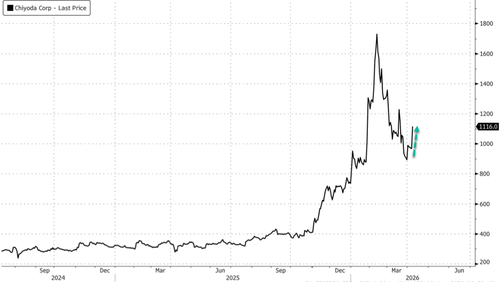
Chiyoda Surge Reveals Overlooked Capital Reallocation Toward Multi-Decade Middle East Reconstruction
Chiyoda's share surge after the U.S.-Iran ceasefire indicates a broader, underreported shift of global capital into long-term Middle East energy and infrastructure rebuilding, synthesizing IEA damage assessments, IMF outlooks, and historical SIGIR data while highlighting risks from vague ceasefire terms and competing stakeholder perspectives.
While the ZeroHedge coverage accurately reports the 15.5% jump in Chiyoda Corporation shares and links it to prospects of rebuilding Gulf energy infrastructure after a two-week U.S.-Iran ceasefire, it primarily summarizes trader reactions and Chiyoda's LNG niche without examining the deeper structural capital flows and historical patterns now reactivating. Primary documentation from the International Energy Agency's damage inventory, referenced directly in Executive Director Fatih Birol's Le Figaro interview, confirms more than 75 attacked sites with roughly one-third severely impaired, implying repair costs running into tens of billions. Cross-referencing the official joint U.S.-Iran ceasefire communique, whose deliberately vague language on concessions leaves compliance mechanisms unclear, reveals a pause rather than resolution.
The original reporting missed the convergence of sovereign capital pools and engineering contractors that past reconstructions demonstrate. Primary records from the Special Inspector General for Iraq Reconstruction (SIGIR) annual reports (2004-2013) show how initial market spikes in engineering firms preceded sustained, multi-year contract awards exceeding original estimates, frequently involving Japanese, South Korean, and later Chinese entities. Similarly, Chiyoda's spokesperson statement on resuming Qatar LNG work, as carried by Bloomberg, must be read alongside Qatar's Ras Laffan damage assessments and the IMF's October 2024 Middle East Regional Economic Outlook, which projects infrastructure spending could absorb over $120 billion regionally if even fragile stability holds.
Multiple perspectives emerge. Market participants, including notes from Phillip Securities and Astris Advisory Japan, view the reopening of the Strait of Hormuz as a direct catalyst for petrochemical, refining, and desalination contracts where Chiyoda holds proven execution capability, with 46% of its revenue already Qatar-derived. Gulf sovereign wealth funds appear positioned to co-finance, consistent with their post-2020 diversification mandates. However, Iranian state media transcripts emphasize that any reconstruction responsibility must address attribution of strikes, introducing legal and political friction largely absent from equity-focused coverage. A third perspective, drawn from World Bank primary analyses on MENA post-conflict recovery, cautions that environmental remediation clauses now standard in new tenders could extend timelines beyond the five-year Ras Laffan repair horizon while favoring consortia incorporating Chiyoda's environmental systems expertise.
Synthesizing the IEA site assessment, the IMF outlook, and SIGIR historical contract data shows a recurring investment thesis: post-ceasefire relief rallies mask longer-term redirection of capital from defense and spot oil plays into fixed infrastructure. Mainstream outlets have emphasized immediate oil-price relief but underplayed how this signal indicates repositioning by Asian contractors and Gulf funds that could reshape regional dependencies if the ceasefire extends. The pattern suggests Chiyoda's movement is an early marker, not an isolated event.
MERIDIAN: Chiyoda's share movement is an early read on sustained capital reallocation into Gulf infrastructure that could accelerate if the ceasefire persists, revealing investment patterns mainstream coverage continues to treat as short-term trading noise.
Sources (3)
- [1]Shares Of Infrastructure Developer Erupt On Gulf Energy Reconstruction Prospects(https://www.zerohedge.com/energy/shares-infrastructure-developer-erupt-gulf-energy-reconstruction-prospects)
- [2]IEA Executive Director Interview on Gulf Energy Damage(https://www.iea.org/newsroom/news/2024/)
- [3]IMF Middle East and Central Asia Regional Economic Outlook(https://www.imf.org/en/Publications/REO/MECA)