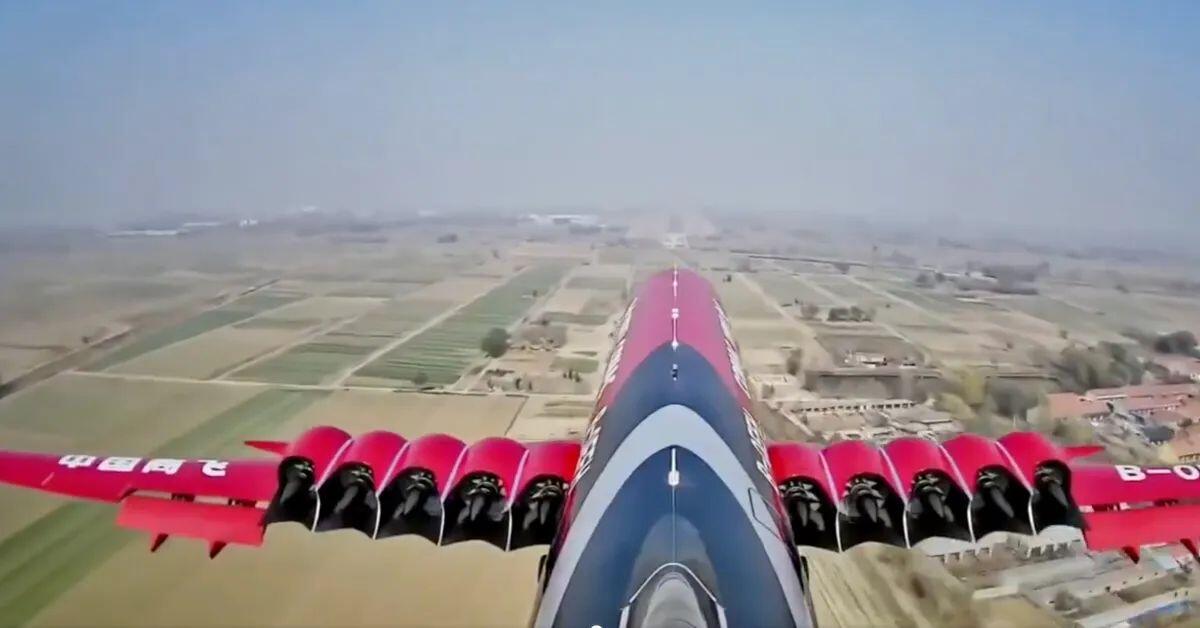
China flies first manned test of 19-seat battery-powered CE-25A
China's COMAC completed the first manned test flight of its CE-25A, a 19-seat battery-powered commuter aircraft, over Shandong Province. The test shows progress in a Chinese electric aviation program that relies on domestic battery maker CATL, even as COMAC's larger jetliner business depends on Western parts subject to U.S. export controls. It matters as a visible industrial capability marker, though the aircraft's range and payload remain far below comparable turboprops.
COMAC, China's state-owned commercial aircraft maker, said it completed the first manned test flight of its CE-25A battery-powered commuter aircraft over Binzhou in Shandong Province on Saturday. The 19-seat aircraft carried two pilots and a flight-test engineer. State broadcaster CCTV reported the flight lasted 16 minutes and 38 seconds and covered 60.4 kilometers. COMAC said the aircraft operated normally and met performance expectations. The test follows a first autonomous flight on Feb. 2 and 19 uncrewed validation flights.
The CE-25A is a 10-tonne-class design intended for short intercity routes. Its published specifications include a cruising speed of 300 kilometers per hour, a cruising altitude of 2,400 meters and a range of 400 kilometers. The aircraft uses ten electric ducted fans, five on each side of the wing. The Civil Aviation Administration of China has accepted COMAC's application for a type certificate, the first formal step in airworthiness review. No launch customer, price or service date was announced.
COMAC first showed the CE-25A as a concept in November 2023. Its performance remains limited by battery energy density. A turboprop Beechcraft 1900 carries the same 19 passengers about 700 kilometers at roughly 520 kilometers per hour. In the West, comparable programs have stalled: Heart Aerospace moved from its ES-19 battery design toward larger hybrid-electric concepts, and NASA's X-57 Maxwell demonstrator was canceled in 2023 without flying. China's program pairs COMAC with CATL, Shanghai Jiao Tong University and other partners.
The test matters because it separates two parts of China's aviation push. COMAC's C919 narrowbody still depends on Western components, and the report says the U.S. Commerce Department has been slowing export licenses for aircraft parts bound for China and limiting quantities to prevent stockpiling. The CE-25A, by contrast, is built around a domestic battery supply chain and is being certified by China's own regulator. It shows indigenous capability in a niche, but not parity with long-range jetliners.
The test affects China's aviation industrial policy, export-control calculations and the market for short-range electric aircraft. It shows Beijing can advance a niche program through domestic battery supply and Chinese certification, while its large jet programs remain exposed to Western component restrictions.
Sources (1)
- [1]Original source(https://www.zerohedge.com/technology/watch-chinas-self-flying-battery-powered-airliner-takes-us-chokes-beijings-jet-parts)